
Medication Hair Loss Timeline Calculator
Your Medication Details
Recovery Timeline
Hair Loss Onset
Peak Shedding
First Regrowth
Full Recovery
Treatment Effectiveness Timeline
When to expect results from common treatments:
- Low-Level Laser Therapy: 4-6 months for visible results
- Minoxidil: 2-8 weeks for initial shedding, 3-6 months for regrowth
- Finasteride: 3-6 months for noticeable results
Important: Don't stop medication without consulting your doctor. Hair loss from non-chemo drugs typically begins 2-4 months after starting medication.
Have you started a new medication and noticed more hair in your brush, shower drain, or on your pillow? You’re not alone. About 4.7 million Americans experience hair loss tied to medications every year. It’s not just about looks - it can shake your confidence, make you feel out of control, or even make you question if something more serious is going on. The good news? In most cases, this kind of hair loss is temporary, and there are real, science-backed ways to fix it.
How Medications Cause Hair Loss
Not all hair loss is the same. When a drug triggers it, there are two main ways it happens - and knowing which one you’re dealing with changes how you handle it. The most common type is called telogen effluvium. This is when the medication pushes your hair follicles into a resting phase too early. Instead of growing, the hairs stop and eventually fall out. This usually starts 2 to 4 months after you begin the medication. You might notice thinning all over your scalp, not just in patches. It’s often linked to antidepressants, blood pressure pills, birth control, and arthritis drugs like methotrexate. About 1% to 10% of people taking these meds see this happen - and for most, it stops once the drug is out of their system. The other type, anagen effluvium, is more dramatic. It happens fast - within days or weeks - and it’s mostly caused by chemotherapy. These drugs attack fast-growing cells, which includes cancer cells… and hair follicles. About 65% of people on chemo lose most of their hair. It’s not just shedding - it’s sudden, widespread loss. But here’s the twist: hair usually comes back faster after chemo ends than it does after telogen effluvium. Regrowth often starts in 3 to 6 weeks.Which Medications Are Most Likely to Cause Hair Loss?
Some drugs are more likely than others. Here’s what the data shows:- Antidepressants (like sertraline, fluoxetine, paroxetine): 5-7% of users report hair thinning
- Birth control pills and hormone therapies: Especially those high in progestin
- Blood pressure meds (beta-blockers, ACE inhibitors): Around 1-3% of users
- Arthritis drugs (methotrexate, leflunomide): Up to 10% of users, especially with long-term use
- Oral retinoids (like Accutane): Nearly 18% of users, often with dry scalp and increased shedding
- Chemo drugs (taxanes, anthracyclines): Up to 65% of patients, with near-total loss
What to Do When Hair Starts Falling Out
First, don’t panic. Don’t stop your medication without talking to your doctor. Many of these drugs are essential for your health. Instead, follow these steps:- Wait 3 months. Hair loss from most non-chemo drugs takes 2-4 months to show up. If you’ve only been on the drug for 6 weeks, give it time. About 85% of telogen effluvium cases fix themselves within 6 months after stopping the drug.
- Track your timeline. Write down when you started the medication and when you noticed more hair falling. If it lines up with the 3-7 month window, that’s a strong clue.
- Don’t assume it’s your hormones. Many women blame menopause or thyroid issues, but if you started a new pill around the same time, that’s probably the trigger.

Proven Treatments That Actually Work
Once you’ve confirmed the medication is the cause and you’ve given your body time to reset, here’s what helps:Minoxidil (Rogaine)
This is the most studied over-the-counter treatment. A 5% solution applied twice daily to the scalp has helped 40-50% of users regain noticeable density after 6 months. But here’s the catch: 89% of people experience a temporary increase in shedding during weeks 2-8. That’s not a sign it’s not working - it’s part of the process. Most people quit before they get to the other side.Finasteride and Dutasteride
These are prescription pills that block DHT, a hormone linked to genetic hair loss. If your medication triggered or worsened pattern baldness, they can help. Finasteride works for 60-65% of users. Dutasteride is slightly more effective (70-75%) but comes with more side effects, like lower libido. They’re not for everyone - especially women who are pregnant or planning to be.Scalp Cooling for Chemo Patients
If you’re on chemotherapy, a cooling cap like the DigniCap can reduce hair loss by 50-65%. It works by lowering scalp temperature during infusion, slowing blood flow to follicles so less chemo reaches them. It’s not comfortable - people report 7.2/10 pain levels during the 90-minute sessions - but for many, it’s worth it. The risk of cancer returning in the scalp is extremely low (0.8%) according to ASCO guidelines.Low-Level Laser Therapy (LLLT)
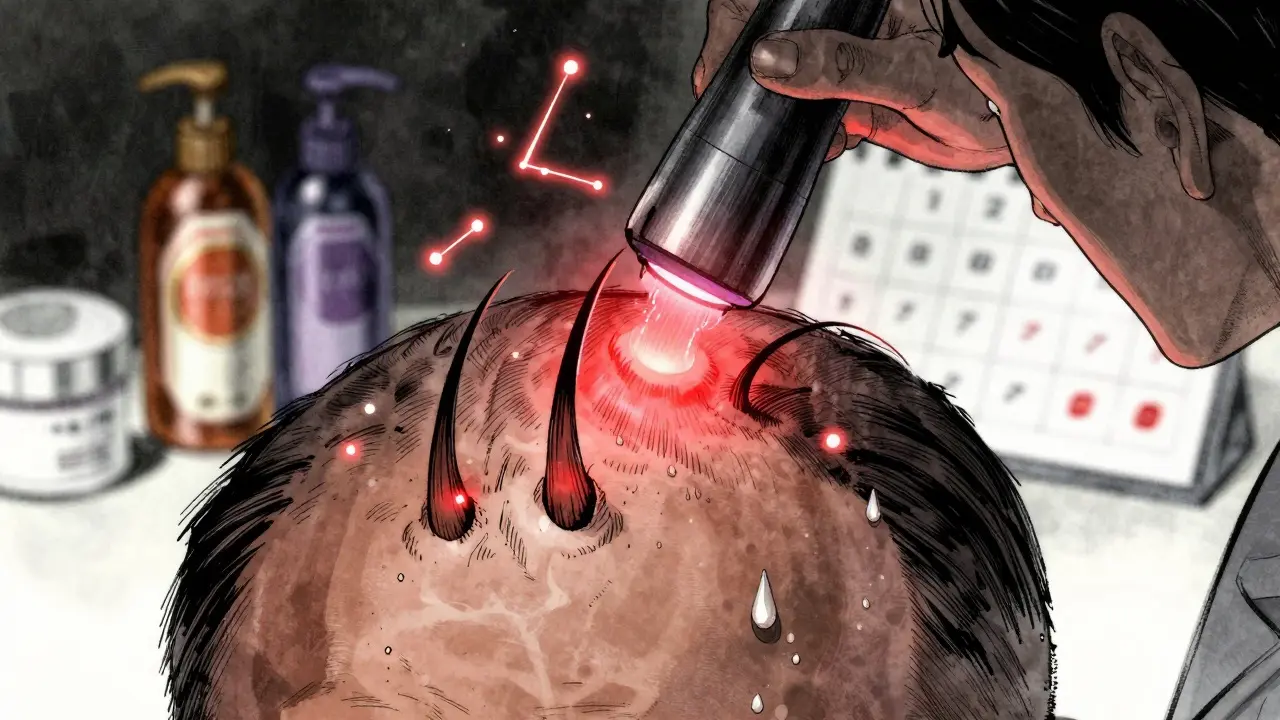
Devices like the iRestore Elite 780 and Capillus82 use red light to stimulate follicles. They’re FDA-cleared and show real results. In one study, users saw 65% improvement in hair density after 26 weeks of daily 20-minute sessions. You need consistency - skip days, and you won’t see results.Nutrition and Supplements
Your hair needs fuel. If you’re on long-term meds, you might be low on key nutrients:- Biotin (5,000 mcg/day): Supports keratin production
- Zinc (15 mg/day): Helps repair follicle tissue
- Iron: Only if your ferritin level is below 70 ng/mL - taking iron when you don’t need it can cause harm
- Folic acid (1 mg/day): Especially helpful if you’re on methotrexate - reduces hair loss severity by 25%
What Doesn’t Work (And Why)
There’s a lot of noise out there. Here’s what to ignore:- Shampoos labeled “for thinning hair” - they don’t penetrate deep enough to affect follicles
- Essential oils applied directly - can irritate the scalp and make shedding worse
- “Natural” hair growth serums with no clinical backing - many are just fancy oils with no proof
When to See a Dermatologist
You should get checked if:- Hair loss lasts longer than 6 months after stopping the medication
- You’re losing hair in patches (could be alopecia areata)
- You have other symptoms like fatigue, weight changes, or skin rashes
- You’re unsure what’s causing it





phara don
2 February 2026 - 20:59 PM
Been on sertraline for 8 months and noticed my ponytail getting thinner... thought it was stress. Glad I’m not crazy. Gonna try minoxidil but scared of the shedding phase 😅
Dan Pearson
4 February 2026 - 14:23 PM
LMAO you people act like losing hair is the end of the world. Back in my day, we didn’t have fancy creams and laser caps-we just shaved our heads and called it a day. Also, Accutane made my hair fall out like a bad sitcom. No biggie. Get over it.
Eli Kiseop
6 February 2026 - 07:06 AM
so i started birth control last year and my hair has been everywhere like its trying to escape my head. i thought it was just my shampoo but now i realize its the pill. thanks for the info
larry keenan
7 February 2026 - 22:08 PM
While the pharmacokinetics of telogen effluvium are well-documented, the heterogeneity in individual response remains underexplored in clinical literature. Genetic polymorphisms in CYP450 enzymes may modulate susceptibility, particularly with SSRIs and beta-blockers. Further cohort studies are warranted to stratify risk profiles.
Nick Flake
8 February 2026 - 12:56 PM
Hey everyone… I just want to say you’re not broken. Your hair isn’t a reflection of your worth. Losing it feels like losing part of yourself-but you’re still whole. I’ve been there. I cried. I wore hats. I tried everything. And guess what? My hair came back… slightly curlier, slightly silverer, and way more badass. You got this. 💪✨
Akhona Myeki
8 February 2026 - 17:54 PM
In South Africa, we don’t have access to these expensive treatments. You people act like hair loss is a crisis. We worry about clean water and electricity. Maybe you should focus on what really matters.
Chinmoy Kumar
8 February 2026 - 18:27 PM
i think this is super helpful! i was on methotrexate for psoriasis and lost like 30% of my hair but i kept taking it because my skin was better. i started biotin and zinc and after 7 months my hair is coming back kinda patchy but its growing! dont give up
Brett MacDonald
10 February 2026 - 11:00 AM
so like… is it just me or does everyone on the internet now have hair loss? like i swear 80% of reddit is either on minoxidil or talking about how their scalp is a desert. maybe we’re just all stressed and drinking too much coffee
Sandeep Kumar
11 February 2026 - 09:04 AM
These so called 'science-backed' solutions are just Big Pharma’s way to sell you more junk. Minoxidil? A topical vasodilator originally developed for hypertension. Finasteride? Turns men into emotional zombies. The real solution? Stop taking pills that make you look like a zombie and live naturally
Gary Mitts
13 February 2026 - 05:21 AM
My doctor said stop the beta-blocker. I did. Hair stopped falling. Took 5 months. Now I’m just waiting for it to grow back. Patience is the real treatment.
Bridget Molokomme
13 February 2026 - 17:21 PM
lol i read the whole thing and now i feel guilty for thinking my hair loss was just from my terrible sleep schedule. turns out it was the birth control. thanks for the guilt trip, internet
Vatsal Srivastava
13 February 2026 - 21:05 PM
Chemo cooling caps? That’s a luxury for the privileged. Most people in India just accept it. No cap, no problem. Your hair is just dead skin. Move on
Brittany Marioni
14 February 2026 - 19:58 PM
Thank you so much for this! I’ve been so anxious about my hair falling out since I started leflunomide-I didn’t know it was normal! I’m going to start the minoxidil and the biotin and the LLLT and the folic acid and… oh my gosh, I’m so relieved to know this isn’t permanent!!!
Monica Slypig
15 February 2026 - 21:52 PM
Why do Americans make everything so complicated? In my country, if your hair falls out you just get a wig. Or shave it. Or wear a scarf. No supplements. No lasers. No drama. Just life.