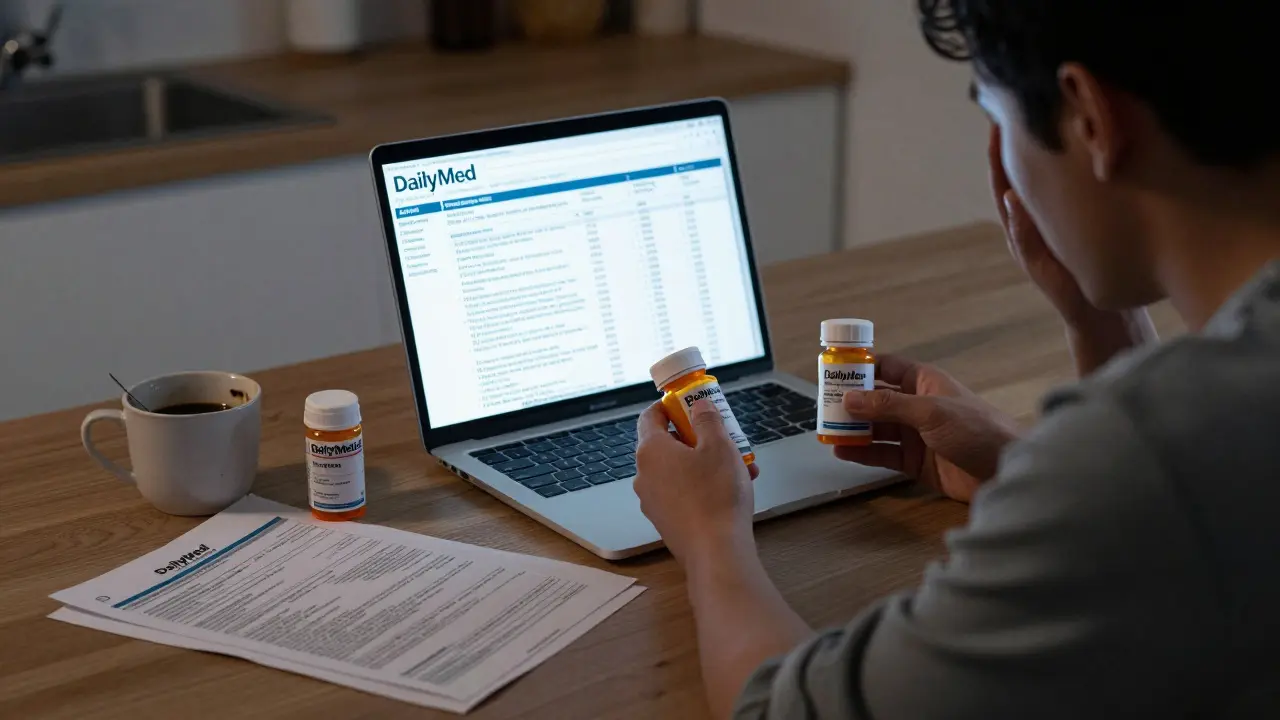
When you’re taking a generic drug, you need to know exactly what you’re getting. Not all generics are the same. Some work just like the brand-name version. Others might have tiny differences in how your body absorbs them - differences that can matter, especially with drugs like levothyroxine, warfarin, or seizure medications. The problem? Many people don’t know where to find accurate, up-to-date info. Google searches lead to ads, forums, and outdated pages. You need trusted sources - the kind pharmacists and doctors actually use.
Why Generic Drug Info Matters More Than You Think
Over 78% of all prescriptions filled in the U.S. are for generic drugs. That’s nearly 4 out of every 5 pills you take. But here’s the catch: just because a drug is labeled "generic" doesn’t mean every version is identical. The FDA says generics must be "therapeutically equivalent" - meaning they work the same way in your body. But sometimes, small differences in how the drug is made affect how it’s absorbed. That’s why knowing which generic you’re getting matters.
The Institute for Safe Medication Practices found that 7.4% of medication errors reported in 2022 were tied to confusion over generic drugs. One patient might get a version from Company A, then refill with Company B - and suddenly feel different. No one told them the two aren’t interchangeable. That’s why reliable sources aren’t optional. They’re essential.
DailyMed: The Official FDA Drug Label Source
If you want the exact wording the FDA approved for a drug - including dosing, warnings, side effects, and storage - DailyMed is your go-to. It’s not a summary. It’s the full, legal labeling document, pulled directly from the manufacturer’s submission to the FDA. No edits. No simplifications.
As of October 2023, DailyMed had over 92,000 drug listings. Every update from the FDA shows up within 72 hours - sometimes faster. That’s critical during safety alerts. If a drug gets a new black box warning, DailyMed reflects it before most other sites even notice.
But here’s the downside: it’s built for professionals. The language is technical. You’ll see terms like "pharmacokinetics," "bioequivalence," and "inactive ingredients." It’s not designed for quick reading. If you’re a patient, you might walk away confused. But if you’re a pharmacist, nurse, or doctor checking for regulatory accuracy? This is the gold standard.
MedlinePlus: The Patient-Friendly Answer
MedlinePlus is what DailyMed should be for regular people. Run by the National Library of Medicine (part of the NIH), it turns complex drug info into plain English. The reading level? 6th to 8th grade. That means a 13-year-old can understand it.
It covers over 17,500 drugs - including generics - with clear sections on uses, side effects, what to avoid, and what to tell your doctor. It even has videos and illustrations. And yes, it’s available in Spanish too.
Patients love it. Google reviews average 4.7 out of 5. People say things like, "I finally understood why my blood pressure meds made me dizzy," or, "I didn’t know grapefruit could mess with my cholesterol pill." But it’s not perfect. It doesn’t list every single generic manufacturer. And it doesn’t explain subtle differences between brands of the same drug. For that, you need more.
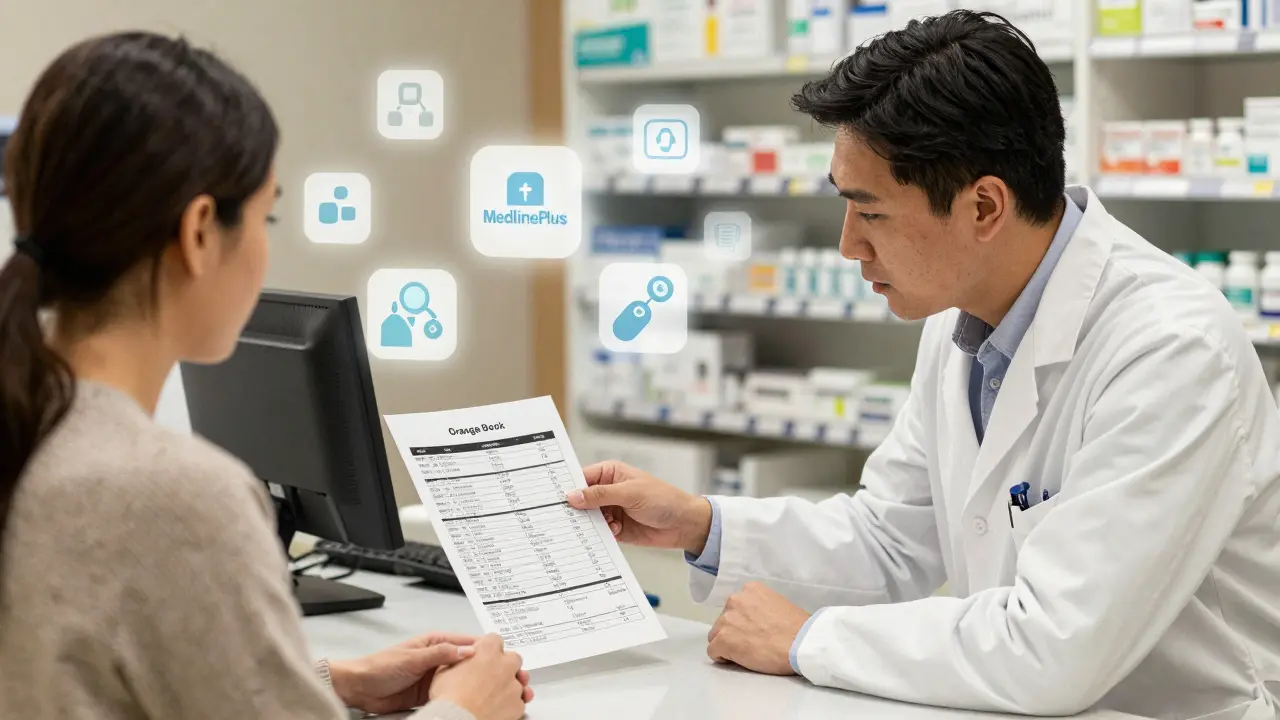
Drugs.com: The Fast, Free All-in-One Tool
Drugs.com is the Swiss Army knife of free drug info. It’s fast. It’s easy. And it’s packed with tools you won’t find elsewhere.
Its Pill Identifier lets you search by shape, color, and imprint - perfect if you find a pill in your purse or your kid’s room. Its interaction checker scans your entire list of meds and flags dangerous combos. In a 2023 Johns Hopkins study, it caught 92.4% of serious drug interactions - better than most free tools.
It pulls data from three major sources: FDA labels, AHFS Drug Information, and Micromedex. That means it’s updated daily. The mobile app is rated 4.6 out of 5 on the App Store. Pharmacists use it during breaks. Patients use it at 2 a.m. when they can’t sleep.
Downside? Ads. Lots of them. And while the info is solid, it’s not the official FDA label. It’s a synthesis. For legal or compliance purposes, always double-check with DailyMed.
The Orange Book: Knowing Which Generics Are Interchangeable
Here’s something most patients don’t know: the FDA rates generics for therapeutic equivalence. That’s the Orange Book. Officially called "Approved Drug Products with Therapeutic Equivalence Evaluations," it tells you which generics can be swapped without changing your outcome.
Each drug gets a code: AB means it’s interchangeable. BX means it’s not. For example, many levothyroxine generics are rated BX - meaning even if they’re "generic," you shouldn’t switch brands without talking to your doctor. That’s because tiny differences in absorption can throw off your thyroid levels.
The Orange Book has over 20,000 generic products listed. You can search it online for free. But it’s clunky. No fancy filters. No mobile app. It’s raw data. Still, if you’re on a narrow-therapeutic-index drug, this is your safety net.
When to Use Which Resource
You don’t need all of them - but you do need to know when to use each one.
- For patient education: Use MedlinePlus. It’s clear, trusted, and free.
- For checking FDA-approved labeling: Go to DailyMed. It’s the law.
- For quick checks, interactions, or pill ID: Drugs.com is your best friend.
- For knowing if you can switch generics: Look up the Orange Book code.
Most pharmacists use at least three of these daily. Community pharmacies rely on DailyMed, MedlinePlus, and Drugs.com because they’re free. Hospitals? They often pay for Lexicomp or Clinical Pharmacology - but even they start with these free tools.

What’s Missing - And Why You Shouldn’t Rely on Google
Google is dangerous for drug info. Ads for "best generic for X" lead to sketchy sites. Blogs say "take it with food" - but the FDA label says "take on empty stomach." You’ll never know which is right.
Reddit and Facebook groups can help - but they’re full of anecdotes. One person says their generic made them tired. Another says it’s fine. That’s not data. That’s luck.
And don’t trust pharmacy websites that only list prices. Price doesn’t equal quality. A cheaper generic might have different fillers, coatings, or release rates. That’s why you need the source, not the storefront.
What’s Coming Next
The FDA is updating the Orange Book in 2024 to include real-world data - like how patients actually respond to different generics. That’s huge. Right now, equivalence is based on lab tests. Soon, it might reflect real patient outcomes.
MedlinePlus is adding multilingual safety alerts in 15 languages by late 2024. That’s a big step for non-English speakers.
And DailyMed’s API now connects to most electronic health records. That means your doctor’s system might pull the latest label automatically - reducing errors before they happen.
Final Takeaway: Trust the Sources, Not the Search Results
Generic drugs save billions. But they also carry hidden risks if you don’t know what you’re taking. The good news? You don’t need to pay for expensive software. The best tools are free, government-run, and updated daily.
Bookmark these four:
- DailyMed - for the official FDA label
- MedlinePlus - for simple, clear explanations
- Drugs.com - for quick checks and interaction alerts
- Orange Book - to see if your generics are interchangeable
Don’t guess. Don’t scroll. Don’t trust random websites. Use these - and you’ll always know what’s in your medicine.
Can I trust generic drugs?
Yes - but only if you know which one you’re getting. The FDA requires generics to be as safe and effective as brand-name drugs. But some generics, especially for drugs with narrow therapeutic windows (like thyroid medicine or blood thinners), can have small differences in how they’re absorbed. Always check the Orange Book for the AB or BX rating. If it’s BX, don’t switch brands without talking to your doctor.
Is DailyMed free to use?
Yes. DailyMed is completely free and doesn’t require registration. It’s run by the National Library of Medicine, part of the NIH. You can access it from any browser on any device. It’s the official source for FDA-approved drug labeling - no cost, no ads, no catch.
Why does my pharmacy give me a different generic every time?
Pharmacies often switch generics to save money. If two generics have the same FDA therapeutic equivalence rating (AB), they’re considered interchangeable. But if your drug has a BX rating, switching could affect how well it works. Always ask your pharmacist: "Is this the same generic I got last time?" And if you feel different after a switch, talk to your doctor - don’t assume it’s "all in your head."
Can I use Drugs.com instead of my doctor’s reference?
Drugs.com is excellent for quick, everyday questions - especially interactions and pill identification. But for legal, regulatory, or clinical decisions (like changing a dose or handling a side effect), always verify with DailyMed or your institution’s official drug database. Drugs.com is a summary. DailyMed is the original source.
Are there apps for this?
Yes. Drugs.com has a top-rated mobile app with a pill identifier and interaction checker. MedlinePlus works on mobile browsers but doesn’t have a dedicated app. DailyMed’s website is hard to use on phones - it’s designed for desktop. For the best mobile experience, use Drugs.com. For the most accurate label, use DailyMed on a tablet or computer.


Nicholas Miter
25 January 2026 - 07:00 AM
Been using Drugs.com for years. Found a pill I didn’t recognize in my kid’s room last month - app ID’d it in 3 seconds. Saved us a trip to the ER.
Henry Jenkins
27 January 2026 - 06:23 AM
I work in a community pharmacy and we rely on DailyMed and MedlinePlus daily. Patients don’t realize how much variation exists between generic manufacturers - especially with levothyroxine. I’ve seen people switch brands and end up with palpitations or fatigue because no one told them the absorption profiles differ. The Orange Book is the real hero here. Most people don’t even know it exists. If you’re on a narrow therapeutic index drug, always check the AB/BX code. It’s not just a footnote - it’s your safety net. I print it out for patients sometimes. They’re shocked it’s free and government-run. Why do we let Google decide what’s safe? That’s the real problem.
Ryan W
27 January 2026 - 11:06 AM
Why are we still talking about free websites? The FDA should mandate that all pharmacies display the Orange Book rating on the label. No excuses. If a generic is BX, it should say so right on the bottle. Not everyone can read a website at 2 a.m. when they’re dizzy. This isn’t a consumer choice - it’s a public health failure. And stop pretending Drugs.com is reliable. It’s a commercial site with ads for supplements. You wouldn’t trust a car manual from a dealership blog. Same thing.
Joanna Domżalska
29 January 2026 - 02:05 AM
So you’re telling me the government runs all this and we still have medication errors? Sounds like a system designed to fail. Maybe the real issue is that generics are just corporate loopholes. The FDA approves them, but they’re still made in the same factories as cheap supplements. You think they care about your thyroid? They care about profit margins. This whole thing is a scam.
Suresh Kumar Govindan
29 January 2026 - 08:34 AM
MedlinePlus is for children. DailyMed is for professionals. Drugs.com is for the lazy. The Orange Book is the only thing that matters. If you don’t understand bioequivalence thresholds or pharmacokinetic variance, you have no business taking generics. Your ignorance is a liability to the healthcare system.
Peter Sharplin
30 January 2026 - 14:56 PM
I’ve been a nurse for 18 years and I still get asked about generic switches. The biggest problem isn’t the resources - it’s that doctors don’t explain it. Patients think "generic" means "same as before." They don’t know about fillers or coating differences. I always print out the Orange Book code for them. And yes, I’ve seen people get sick after switching - especially with warfarin. One guy’s INR spiked to 6.5 because his pharmacy switched brands and no one told him. He almost bled out. This isn’t theoretical. It’s life or death. Use the tools. But more importantly - ask your doctor and pharmacist. Don’t assume.
Allie Lehto
1 February 2026 - 07:56 AM
Why do we even need this? Why can’t the drug companies just make one version that works? Why are we all just… guessing? It’s like buying shoes and never knowing if they’ll fit. And now we’re supposed to be experts? I just want to take my pill and not think about it. This is exhausting. 😔
Josh josh
3 February 2026 - 04:25 AM
Drugs.com saved my life when I found that weird blue pill in my couch. Turned out it was my grandpa’s blood thinner. I almost took it. Thank god for the pill identifier. Also, the interaction checker caught that my CBD oil was messing with my seizure med. I didn’t even know that was a thing. Free tools > paid apps any day. And yeah the ads suck but I just use adblock. No biggie.
Shawn Raja
4 February 2026 - 04:19 AM
Let’s be real - the whole generic system is a joke. The FDA says "therapeutically equivalent" but they test on healthy volunteers in labs. What about the 70-year-old with kidney disease? Or the diabetic on five meds? Real bodies aren’t lab rats. And yet we’re told to trust a code. AB? BX? Who even made these rules? And why is DailyMed still using 2005-era web design? This isn’t progress. It’s bureaucratic theater. We need real-world data, not lab numbers. The FDA’s 2024 update might actually mean something - if they stop pretending this is just a paperwork game.
Rakesh Kakkad
5 February 2026 - 08:30 AM
As a pharmacist in Mumbai, I can confirm: the issue is global. Patients here switch generics daily based on price. No one checks the Orange Book. No one understands bioequivalence. We rely on DailyMed and MedlinePlus to translate into local languages for our patients. But the infrastructure is lacking. We need mobile-friendly versions of these tools in Hindi, Tamil, Bengali. Until then, we’re playing Russian roulette with people’s health. The resources exist. The will does not.
Dan Nichols
6 February 2026 - 01:43 AM
Henry Jenkins said it best - but you’re all missing the point. The real problem is that we treat drug info like a consumer product. It’s not. It’s a clinical tool. If you don’t understand the difference between a pill identifier and a regulatory label, you shouldn’t be making decisions about your meds. Stop using Reddit. Stop trusting ads. Stop treating your health like a Google search. Use the sources. Or don’t. But don’t complain when it goes wrong.