
The Invisible Shield Behind Your Medicine
Imagine swallowing a pill that could make you sick before it even fixes your problem. That risk used to be higher, especially when factories rushed to produce cheaper versions of life-saving treatments. Today, Cleanroom Standards act as the invisible shield protecting every generic medication. These aren't just empty rooms with sterile air; they are highly engineered environments where temperature, humidity, and particle counts are monitored constantly. When you pick up a generic version of a popular drug, you expect it to work exactly like the original brand-name product. But how does a factory ensure that chemical equivalence isn't ruined by a speck of dust or a stray bacterium?
The answer lies in strict environmental controls mandated by global regulators. For generic manufacturers, meeting these benchmarks isn't optional-it's a pass-or-fail condition for getting approval. If the environment fails, the drug is useless, or worse, dangerous. We need to look beyond the marketing labels and understand the technical requirements that keep supply chains safe.
Cleanroom Standards represent systematically defined environmental controls that regulate airborne particles, microbial contaminants, and facility parameters to ensure pharmaceutical product integrity.Understanding the Grading System
To talk about quality, we first need to understand the scale used to measure it. The industry doesn't use a single rulebook; instead, it relies on a tiered system known as grading. The most widely recognized framework comes from the European Union, which aligns closely with international norms. These grades determine how many particles are allowed in the air per cubic meter. Let's break down the four critical levels that define modern .
| Grade | ISO Equivalency | Particles ≥0.5μm (Operational) | Air Changes/Hour |
|---|---|---|---|
| Grade A | ISO Class 5 | ≤ 3,520 particles | Minimum 60 |
| Grade B | ISO Class 7 | ≤ 3,520,000 particles | Minimum 40 |
| Grade C | ISO Class 8 | ≤ 35,200,000 particles | Minimum 20 |
| Grade D | ISO Class 8 (Rest) | No operational limit | Minimum 10 |
Grade A is the gold standard. This is where sterile products like injectables get filled into vials. It requires unidirectional airflow moving at specific speeds (0.36 to 0.54 meters per second) to sweep contaminants away. Grade B acts as the buffer area surrounding Grade A zones. If you step out of Grade A, you enter Grade B. Even a slight drop in pressure between these zones can cause contamination to flow the wrong way, turning a safe process into a hazard.
Why Generic Drugs Face Higher Scrutiny
You might wonder why the conversation shifts so often to generic drugs specifically. The short answer is money and trust. Brand-name innovators have larger profit margins, often sitting between 70% and 80%. Generic manufacturers, by contrast, operate on thin slices-often just 15% to 20%. Despite having less revenue to spend on maintenance, the law demands they meet the exact same safety standards as the original creator.
This creates a difficult balance. A generic company might try to cut corners to save the $250 to $500 per square foot needed to build an ISO Class 5 environment. They can't. Regulatory authorities like the U.S. Food and Drug Administration enforce strict equivalency requirements. Under the Orange Book regulations, a generic must prove bioequivalence to the reference listed drug. If the cleanroom allows too many particles during manufacture, the drug formulation changes. The pills might dissolve differently, or the solution gets cloudy. That failure means the product is rejected.
We see this play out in enforcement data. In fiscal year 2022 alone, 63% of all warning letters issued were related to Current Good Manufacturing Practices (cGMP). Many of these failures traced back to environmental monitoring gaps. Companies didn't catch a spike in viable microbial counts until patients reported issues.
The Global Web of Regulations
Manufacturing doesn't stop at borders, so neither do the rules. While the FDA governs the American market, the European Medicines Agency (EMA) sets the pace for Europe and influences global harmonization. The backbone of this system is the ISO 14644-1 standard. First published in 1999 and updated in 2015, it provides the globally recognized particle classification that underpins regional rules.
In the United States, the FDA operates under 21 CFR Parts 210 and 211. These codes emphasize facility design that prevents contamination but are less specific about ISO classes than their European counterparts. Meanwhile, the European Union formalized its rules through EudraLex Volume 4, specifically Annex 1 governing sterile manufacturing. A significant update took effect in August 2023, requiring continuous monitoring systems. This change forces companies to move away from periodic sampling toward real-time data streams.
Harmonization efforts through the International Council for Harmonisation (ICH) help align these differences. Guidelines like ICH Q7 cover active pharmaceutical ingredients. Without this coordination, a factory couldn't easily export products across regions. Yet, discrepancies remain. For instance, Japanese Pharmaceutical Affairs Law (PAL) aligns with ICH standards but adds monitoring at 1.0μm particle sizes. This extra layer ensures consistency for local markets while adding complexity for multinational suppliers.
The Hidden Costs of Compliance
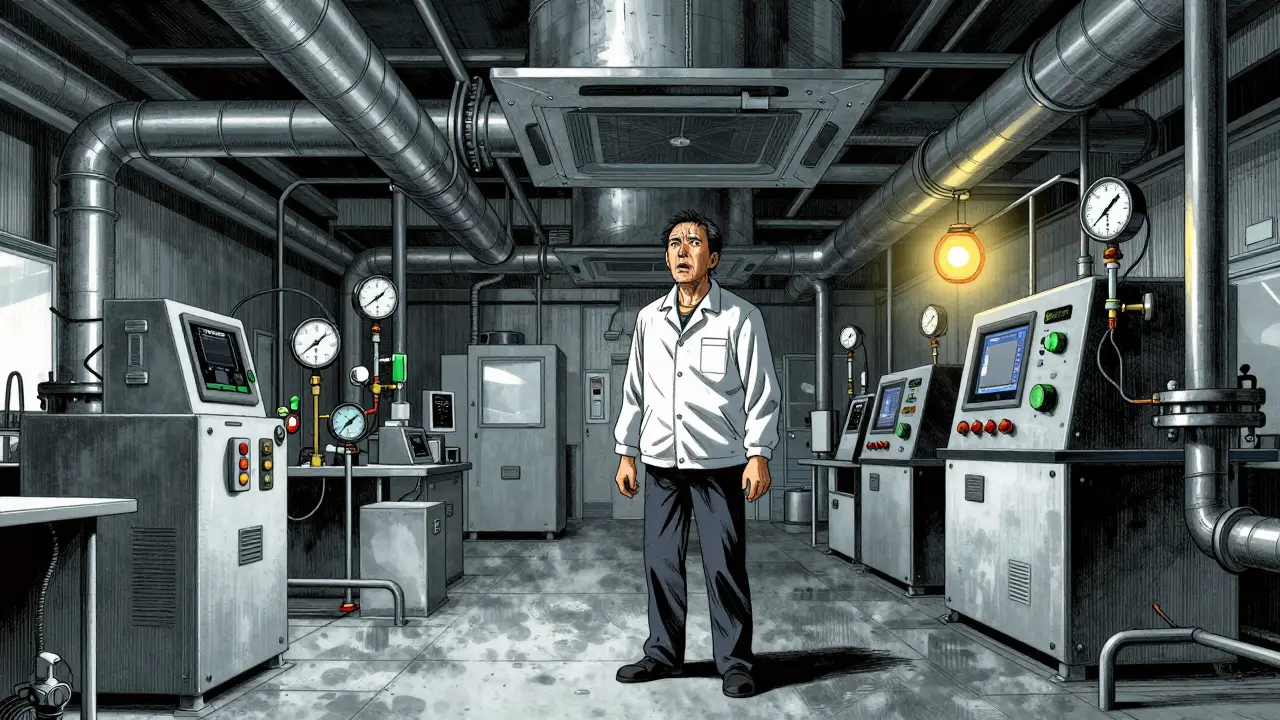
Maintaining these environments is expensive. The initial capital expenditure for a compliant facility consumes 15% to 25% of total investment for generic manufacturers. This ratio is double that of brand-name drug makers who can absorb costs over longer development lifecycles. Consider HVAC systems alone. Keeping humidity between 30% and 60% in tropical climates requires specialized dehumidification that can add 30% to the budget.
A real-world example comes from a Pfizer facility manager described in ISPE forums. Converting a zone from Grade C to Grade B for a generic oncology product required a $2.3 million HVAC upgrade and 14 months of downtime. However, the trade-off saved them from potential batch failures valued at $8.5 million annually. For smaller players, the math is harder. Reports suggest some small manufacturers found maintaining Grade A environments impossible for low-margin syringes after repeated inspection excursions.
Personnel training also eats into budgets. Staff need 40 to 60 hours of training just for gowning certification. One study found that personnel behavior remains the most frequent source of deviations, accounting for 42% of issues cited in compliance audits. Human movement disrupts airflow patterns. If a worker moves too quickly near an open vial fill line, they carry static charge and skin cells into the sterile field. Technology helps, but human error remains a variable.

Risks of Non-Compliance
Failure to meet these standards carries severe consequences beyond lost revenue. The FDA uses several tools to punish non-compliance, starting with Form 483 observations during inspections. If corrections aren't made, a warning letter follows. More severe actions include import alerts that block shipments entirely. In extreme cases, product recalls happen.
We saw this clearly in the 2012 New England Compounding Center meningitis outbreak. Inadequate environmental controls led to contaminated steroids, causing deaths and permanent disability. This event fundamentally changed how regulators view compounding pharmacies versus manufacturing plants. Another recent case involved Aurobindo Pharma, where inadequate monitoring of Grade B areas led to a consent decree and a $137 million recall of sterile injectables in 2022.
These stories highlight that cleanroom violations aren't just paperwork errors. They are direct threats to patient safety. Every recalled unit represents a family potentially exposed to unsafe medicine. That reality keeps the regulatory bar high. Inspections are becoming more frequent, with data showing 92% of FDA-inspected generic facilities now maintaining Grade A/B environments for sterile products compared to 78% just a few years ago.
Technology Driving the Future
Looking ahead, the burden of manual monitoring may lighten. Automation and AI are beginning to transform these spaces. McKinsey projections suggest operational costs could drop by 30% by 2028 through robotics and smart monitoring systems. Continuous Manufacturing (CM) is another trend. Instead of batch processes, CM integrates steps, requiring cleaner integration lines.
The FDA is already updating guidance for solid dosage forms produced this way. By 2025, roughly 50% of new Abbreviated New Drug Applications (ANDAs) will likely require Grade A/B environments, up from 35% previously. This shift reflects the rise of complex generics, like biosimilars and inhalers, which demand stricter control than basic tablets. Single-use technologies are also entering the mix, reducing cleaning burdens between batches. As technology evolves, so does the definition of quality.
Frequently Asked Questions
What is the difference between ISO Class 5 and Grade A?
They are effectively equivalent in practice. Grade A is the European term used in GMP standards that corresponds directly to ISO Class 5 regarding particle limits (3,520 particles per m³ at 0.5μm). The terminology differs by region, but the physical requirements remain aligned for sterile manufacturing zones.
Why do generic drug manufacturers struggle with cleanroom costs?
Generic manufacturers typically operate on gross margins of 15% to 20%, whereas brand-name innovators enjoy margins of 70% to 80%. High infrastructure costs, like $500 per square foot for cleanroom construction, consume a much larger percentage of their available operating capital.
How often must cleanrooms be monitored?
Monitoring frequency depends on the grade. Grade A zones require continuous monitoring for particulate matter and pressure differentials. Lower grades often require periodic sampling, though new 2023 revisions are pushing for continuous data logging across all sterile critical areas.
Who enforces cleanroom standards in the US?
The U.S. Food and Drug Administration (FDA) enforces these standards under the Current Good Manufacturing Practices (cGMP) regulations outlined in 21 CFR Parts 210 and 211. Their Office of Generic Drugs conducts regular facility inspections.
Can a generic drug be approved if it doesn't meet cleanroom specs?
No. Approval requires proof that manufacturing meets cGMP. If environmental controls fail during validation studies, the FDA will issue a Complete Response Letter citing deficiencies until the facility demonstrates compliance.

Lawrence Rimmer
1 April 2026 - 20:31 PM
It is mostly just a way to keep us afraid of pills made cheaply.
Hope Azzaratta-Rubyhawk
1 April 2026 - 22:03 PM
We demand absolute excellence from our healthcare systems regardless of the margin. Safety protocols cannot be compromised for the sake of profit margins alone.
The industry must adhere to the highest standards available today.
simran kaur
3 April 2026 - 06:30 AM
These regulations are likely just a distraction from the real failures in oversight.
They claim purity while the supply chain moves through questionable zones. Trust is easily broken when profits drive decisions.
Ace Kalagui
3 April 2026 - 06:35 AM
We see different approaches depending on where you look globally.
The Indian market has unique challenges compared to western counterparts.
Infrastructure spending varies wildly between emerging and developed economies.
You cannot compare a rural setup to a high-tech lab in Europe.
Local governments push for self-reliance in pharmaceutical production often.
This drive for autonomy sometimes overlooks the strict particle counts we need.
Maintaining ISO Class 5 requires consistent power which isn't guaranteed everywhere.
We need better investment strategies rather than just copying rules blindly.
Training personnel takes massive amounts of time and budget allocation.
The human factor remains the biggest risk in any developing facility.
Technology can help bridge the gap between rich and poor nations.
AI monitoring could reduce the reliance on perfect human behavior constantly.
We must recognize that local conditions dictate how we enforce these grades.
Flexibility without compromising safety is the ultimate goal for everyone.
Global harmonization helps but regional nuances still define success metrics.
Aysha Hind
4 April 2026 - 02:44 AM
The narrative always focuses on the tech specs while ignoring the shadow deals.
Cleanrooms become excuses for price hikes in the long run. People get sick and nobody tracks the root cause properly.
sophia alex
5 April 2026 - 17:23 PM
US facilities stay ahead because we refuse to cut corners on quality control 🇺🇸.
European standards lag behind our rigorous FDA enforcement mechanisms every single time 💊.
Jenna Carpenter
6 April 2026 - 10:00 AM
U r talking too much about culture when it shuld be abut govnt regulation failrues.
The main issu isthe manuafcturers tryng to cheep out on HVAC units instead of fixin teh problem. Recieve warnings but do nothing.
Brian Shiroma
6 April 2026 - 20:49 PM
Nobody actually reads the technical manuals before demanding perfection here.
Everyone thinks the FDA is magic dust that fixes bad engineering practices overnight.