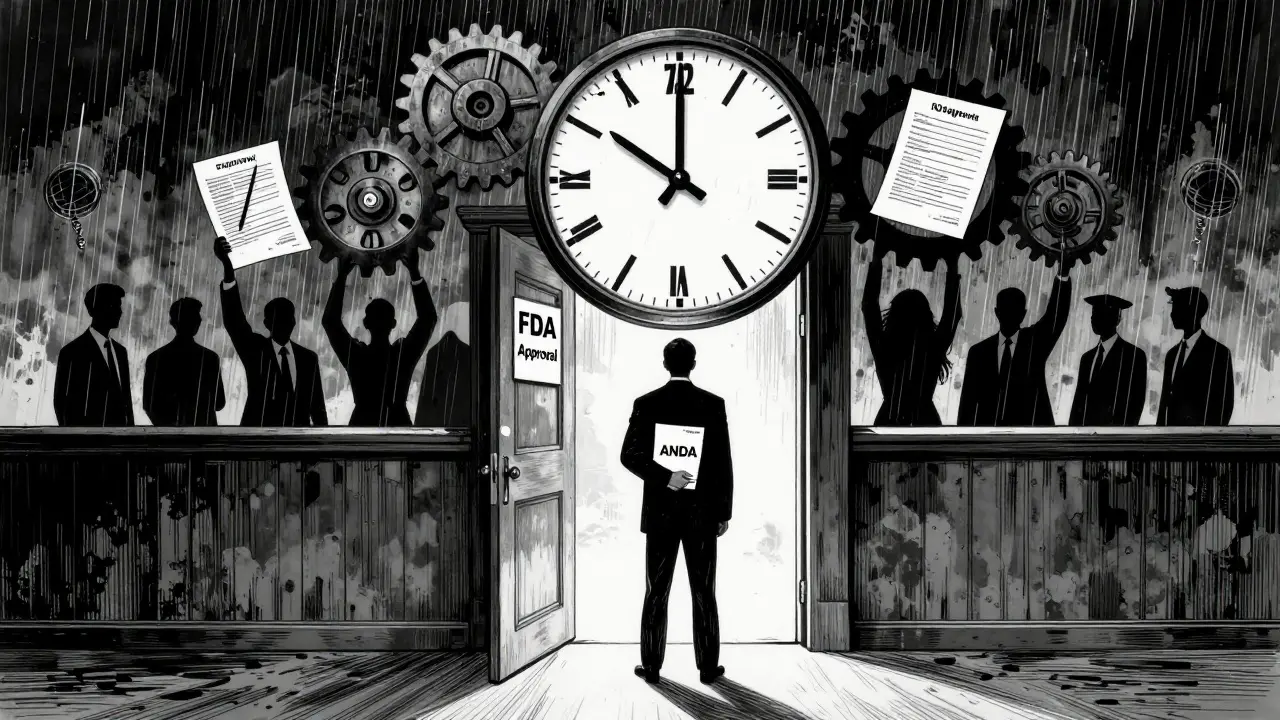
When a brand-name drug hits the market, it usually has a patent that gives the company exclusive rights to sell it for about 20 years. But that clock doesn’t start ticking from the day the patent is filed-it starts when the drug gets FDA approval. By the time a drug reaches patients, the patent might already have five or six years eaten up by clinical trials and regulatory review. That’s why Congress passed the Hatch-Waxman Act in 1984. It was meant to strike a balance: let generic drugmakers enter the market faster, but give brand companies enough time to protect their investment. One of its most powerful tools? The 30-month stay.
What Exactly Is the 30-Month Stay?
The 30-month stay is a legal pause on FDA approval for a generic drug. It kicks in when a generic company files what’s called a Paragraph IV certification. That’s their way of saying, "We think your patent is invalid or we don’t infringe it." If the brand-name company sues within 45 days, the FDA can’t approve the generic for up to 30 months-even if the generic’s drug is scientifically perfect and ready to go. This isn’t a court ruling. It’s an automatic administrative hold. The FDA doesn’t decide if the patent is valid. It just hits pause. The clock starts the day the last patent holder gets notice of the Paragraph IV filing. And here’s the catch: the FDA can still review the application during this time. They can even give tentative approval. That means the generic is cleared on paper, but they can’t sell it until the stay ends. In 2022, the FDA gave tentative approval to 78% of ANDAs still under patent litigation. That’s 816 applications sitting in limbo, ready to launch the moment the legal fog clears.Why Does This Delay Generic Drugs?
At first glance, 30 months sounds like a fair buffer. But in practice, it’s often just the beginning of the delay. The median time between a brand drug’s approval and a generic challenge? About 5.2 years. The median time between the end of the 30-month stay and when the generic actually hits shelves? A full 3.2 years. That’s over three years after the legal barrier is gone-and still no generic in sight. Why? Because the real delay isn’t the 30 months. It’s what happens before and after. Brand companies often file multiple patents on minor changes: a new pill coating, a different dosage form, a new method of use. Even though the 2003 Medicare law stopped them from getting multiple 30-month stays for the same generic applicant, they still file new patents as old ones expire. Each one can restart the clock-or at least delay the launch through legal noise. A 2019 Brookings study found that 67% of patents listed for top-selling drugs were filed after the original drug approval. These aren’t breakthrough innovations. They’re tweaks. But under current rules, they still trigger stays. And then there’s the settlement problem. In 2017, the FTC found that 78% of patent lawsuits between brand and generic companies ended in settlements. Many of these settlements included deals where the generic company agreed to delay launch in exchange for cash or other perks. These are called "pay-for-delay" agreements-and they’re legal, even though they keep prices high.Who Benefits? Who Loses?
The brand companies argue the 30-month stay is essential. Without it, they say, no one would invest in new drugs. Scott Gottlieb, former FDA commissioner, points out that since 1984, over 12,000 generics have been approved, saving consumers $2.2 trillion. That’s real money. But the cost of delay is staggering. The FTC estimates that patent litigation delays, including the 30-month stay and pay-for-delay deals, add $13.9 billion to U.S. drug costs every year. For patients on expensive medications like insulin or cancer drugs, that delay can mean thousands in out-of-pocket costs. Generic manufacturers aren’t sitting idle. They spend $3-5 million per ANDA just on legal fees. And they start preparing for litigation years before the patent expires. One Teva regulatory specialist noted on a pharma forum that the 30-month stay often gives brand companies a false sense of security. The real bottleneck isn’t the law-it’s their own internal delays. The generic is ready. The FDA says go. But the brand company’s commercial team isn’t prepared to compete on price.
How Does This Compare to Other Countries?
The U.S. is an outlier. In the European Union, there’s no patent-linked stay at all. Generic companies can file for approval as soon as the patent expires. Canada has a 24-month stay, but it’s shorter and less frequently triggered. The U.S. system is the only one that ties regulatory approval directly to patent litigation outcomes. That makes the U.S. unique-but not necessarily better. In 2022, the FDA approved only 782 final ANDAs out of 1,046 submitted. The rest were blocked by patent or exclusivity issues. That’s a 25% rejection rate not because the drugs were unsafe or ineffective, but because of legal delays.What’s Changing? The Push for Reform
There’s growing pressure to fix this. The FDA’s 2023 draft guidance wants stricter rules on what patents can be listed in the Orange Book. No more listing patents on packaging or unused methods of use. Congress is also stepping in. The Affordable Prescriptions for Patients Act, introduced in early 2023, proposes cutting the 30-month stay to 18 months and banning stays for secondary patents. The FTC has called the current system a "patent thicket"-a web of overlapping patents designed to block competition. If these reforms pass, over $78 billion in branded drugs set to lose patent protection by 2028 could see generics arrive faster. That could save consumers $195 billion, according to Evaluate Pharma. But the drug industry isn’t backing down. PhRMA warns that shortening the stay could cut R&D investment by $14 billion a year and delay dozens of new drugs. They argue the system works-it’s just being misused.What Does This Mean for Patients?
If you’re waiting for a cheaper version of your medication, the 30-month stay is likely the reason it’s not on the shelf yet. Even after the patent expires, you might wait years. The FDA approves the drug. The generic maker is ready. But the courts, the settlements, the patent games-they’re still in the way. The system was designed to balance innovation and access. But today, it often feels like a delay machine. The 30-month stay isn’t the villain. It’s the tool. And like any tool, it’s only as good as the hands that use it.
What Happens After the Stay Ends?
Once the 30-month clock runs out-or if the court rules in favor of the generic-the FDA lifts the hold. But that doesn’t mean the drug immediately hits pharmacies. The first company to file a successful Paragraph IV application gets 180 days of exclusive marketing rights. That’s a huge incentive. So if two companies challenge the same patent, they race to file first. In 2022, 72% of drugs faced multiple Paragraph IV challenges-up from 58% in 2018. The winner gets a head start. The others wait. And sometimes, the winner doesn’t launch right away either. They wait for the right pricing window. Or they negotiate with the brand company. The market is complicated.Can You Track This?
Yes. The FDA’s Orange Book lists all patents linked to brand drugs. It’s public. Generic companies use it to plan their challenges. Patients and advocates can use it too. If your drug has 8 patents listed, that’s a red flag. It doesn’t mean the drug is better-it means someone’s trying to keep generics out. The FDA also publishes monthly data on ANDA submissions and approvals. Tentative approvals are tracked separately. If a drug has been tentatively approved for over a year, it’s likely stuck in litigation or a settlement.Bottom Line
The 30-month stay was never meant to be a 5-year delay. It was meant to be a bridge-giving brand companies time to defend their patents without blocking generics indefinitely. Today, it’s often a roadblock. The real issue isn’t the law. It’s how it’s used. Patent thickets. Pay-for-delay deals. Strategic litigation. These aren’t bugs in the system. They’re features. Patients pay the price. So do taxpayers. So does the U.S. healthcare system. Reform is coming. Whether it’s enough to fix the imbalance? That’s the next chapter.What triggers a 30-month stay for a generic drug?
A 30-month stay is triggered when a generic drug manufacturer files an Abbreviated New Drug Application (ANDA) with a Paragraph IV certification, challenging the validity or enforceability of a patent listed in the FDA’s Orange Book. If the brand-name drug company files a patent infringement lawsuit within 45 days of receiving notice of this certification, the FDA is legally required to delay final approval of the generic drug for up to 30 months.
Can the FDA approve a generic drug during the 30-month stay?
Yes, the FDA can and often does issue tentative approval during the 30-month stay. This means the generic drug meets all scientific and regulatory requirements for approval, but the FDA cannot grant final approval until the stay ends-either after 30 months, if the litigation is resolved earlier, or if a court rules in favor of the generic manufacturer.
Does the 30-month stay always last exactly 30 months?
No. The stay lasts up to 30 months, but it can end earlier if the court rules in favor of the generic company or if the patent is found invalid or not infringed. It can also be extended beyond 30 months if the litigation is not resolved by then, though this is rare and usually requires a court order.
Why do some generic drugs launch years after the 30-month stay ends?
The 30-month stay only blocks FDA approval-it doesn’t control when the generic company decides to launch. Many factors delay launch after the stay ends, including settlement agreements with brand companies, internal commercial planning, manufacturing readiness, and the 180-day exclusivity period granted to the first filer, which can create a race or coordination among multiple generic applicants.
How does the 30-month stay affect drug prices?
The 30-month stay delays generic competition, which keeps brand-name drug prices high. The FTC estimates that patent litigation delays, including stays and pay-for-delay settlements, add $13.9 billion annually to U.S. drug spending. Once generics enter, prices typically drop by 80-85% within the first year.
Are there efforts to change the 30-month stay rule?
Yes. In 2023, legislation was introduced to shorten the stay from 30 to 18 months and ban stays for secondary patents filed after the original drug approval. The FDA is also proposing stricter rules on which patents can be listed in the Orange Book. These reforms aim to reduce delays caused by patent thickets and pay-for-delay deals.



Angela Spagnolo
27 December 2025 - 08:12 AM
Okay, so I just read this whole thing... and I’m crying? Not because I’m emotional, but because I’m so tired of this system. I’ve been on insulin for 8 years, and my copay went from $30 to $140 because the generic never launched, even though the patent expired in 2021. Why? Because someone filed a patent on the color of the pill cap. I’m not joking. I’ve seen the Orange Book. There are 11 patents listed. Eleven. For one vial. I’m exhausted.
david jackson
28 December 2025 - 15:04 PM
Let me just say this: the 30-month stay was never meant to be a 5-year delay, but here we are, watching brand-name companies turn patent law into a game of Jenga where every block is a minor tweak to the pill’s coating or the shape of the logo on the bottle. And the FDA? They’re just sitting there, holding the stack, saying ‘I’m just the messenger.’ Meanwhile, people are skipping doses because they can’t afford the brand. This isn’t innovation-it’s extortion with a law degree. And don’t even get me started on pay-for-delay. That’s not a settlement, that’s a cartel with a subpoena.
Jody Kennedy
30 December 2025 - 03:45 AM
Y’all need to stop acting like this is some new problem. This has been going on since the 90s. I worked in pharma compliance back then. The system was broken then, and now it’s just… polished. Like a rusty car with new paint. The 30-month stay? It’s a legal loophole dressed up as a bridge. And guess who’s stuck on the other side? The people who need the meds. I’m so tired of hearing ‘innovation’ as an excuse. Innovation is inventing a new drug-not filing 17 patents on how you hold the bottle. We need real reform, not buzzwords.
christian ebongue
30 December 2025 - 19:58 PM
generic companies spend $5mil on lawyers just to get a drug approved? wow. and the brand companies? they just sit back and wait for the check. classic. also, the 180-day exclusivity? that’s just a fancy way of saying ‘first come, first served, unless you’re rich enough to pay the first guy to wait.’
jesse chen
1 January 2026 - 04:02 AM
I’ve been reading up on this for months now, and honestly, the part that breaks my heart is the tentative approvals. 816 applications sitting there, cleared by the FDA, but still locked behind legal paperwork. It’s like they built a highway but put a gate at the end and said ‘come back when we feel like it.’ And the worst part? The people who need these drugs don’t even know they’re waiting for something that’s already approved. They just think the system is broken. It’s not broken-it’s being abused.
Joanne Smith
2 January 2026 - 13:03 PM
Oh, so the 30-month stay is just a fancy name for ‘we’re gonna drag this out until you give up or go broke.’ I love how they call it a ‘balance’-like the scales are tipped with gold-plated lawyers on one side and diabetic grandmas on the other. And the Orange Book? That’s not a directory, it’s a bingo card for patent trolling. If your drug has more than 3 patents, you’re not innovating-you’re gaming. And don’t even get me started on the ‘180-day exclusivity’-that’s just the FDA’s way of saying ‘congrats, you won the lawsuit, now be the monopoly for six months.’
Prasanthi Kontemukkala
3 January 2026 - 13:54 PM
Thank you for sharing this. I come from India, where generics are cheap and available almost immediately after patent expiry. Here, I see families choosing between medicine and food. I know the system was meant to protect innovation, but when the protection becomes a wall, it stops serving the people it was meant to help. Maybe we need to think of patents as tools for fairness, not weapons for delay. Small changes can make a big difference-for everyone.
Lori Anne Franklin
4 January 2026 - 18:57 PM
i just found out my dad’s med has been tentatively approved for 18 months and still no launch… i didn’t even know that was a thing. i thought the FDA just approved it and boom, it’s on the shelf. why is this so complicated?? i just want him to pay less. that’s it. not rocket science.
Bryan Woods
5 January 2026 - 13:42 PM
It’s worth noting that the 30-month stay was never intended as a permanent injunction. The fact that it’s being weaponized through strategic patent filings and litigation delays reflects a systemic failure of oversight, not a flaw in the original legislation. Reform is necessary, but it must be precise-targeting abuse, not innovation.
Ellie Stretshberry
5 January 2026 - 17:47 PM
this is why my insulin is still 500 bucks even though the patent expired 3 years ago