
Medical Code Translator
Understand Your Medical Terms
Enter a medical code or term you've seen in your records to get a plain-language explanation.
Examples: E11.9, ICD-10, hypertension, diabetes, heart attack
Enter a medical code or term to see the translation
Common Medical Terms
Why Your Doctor’s Notes Don’t Sound Like You
You walk out of the doctor’s office with a piece of paper that says "Type 2 Diabetes Mellitus, E11.9". You nod, smile, and try to remember what that means. Later, you look it up online and feel confused-or worse, guilty. You didn’t know "E11.9" wasn’t a diagnosis you failed. It’s just a code. But your doctor didn’t say that.
Meanwhile, your doctor wrote down "poorly controlled DM" because that’s what the system asks for. They didn’t mean to make you feel like you’re failing. They just used the language their training and software require. This gap isn’t a mistake. It’s a system design flaw-one that affects millions of patients every year.
The Two Languages of Health
Healthcare providers speak in codes. Patients speak in feelings.
Doctors use ICD-10 codes-over 70,000 of them-to classify diseases. They use CPT codes to bill for procedures. These are standardized, precise, and required by Medicare, insurance companies, and electronic health records like Epic and Cerner. But none of those codes tell you what it feels like to wake up tired every day, to be constantly thirsty, or to fear your next blood test.
Patients? They say things like:
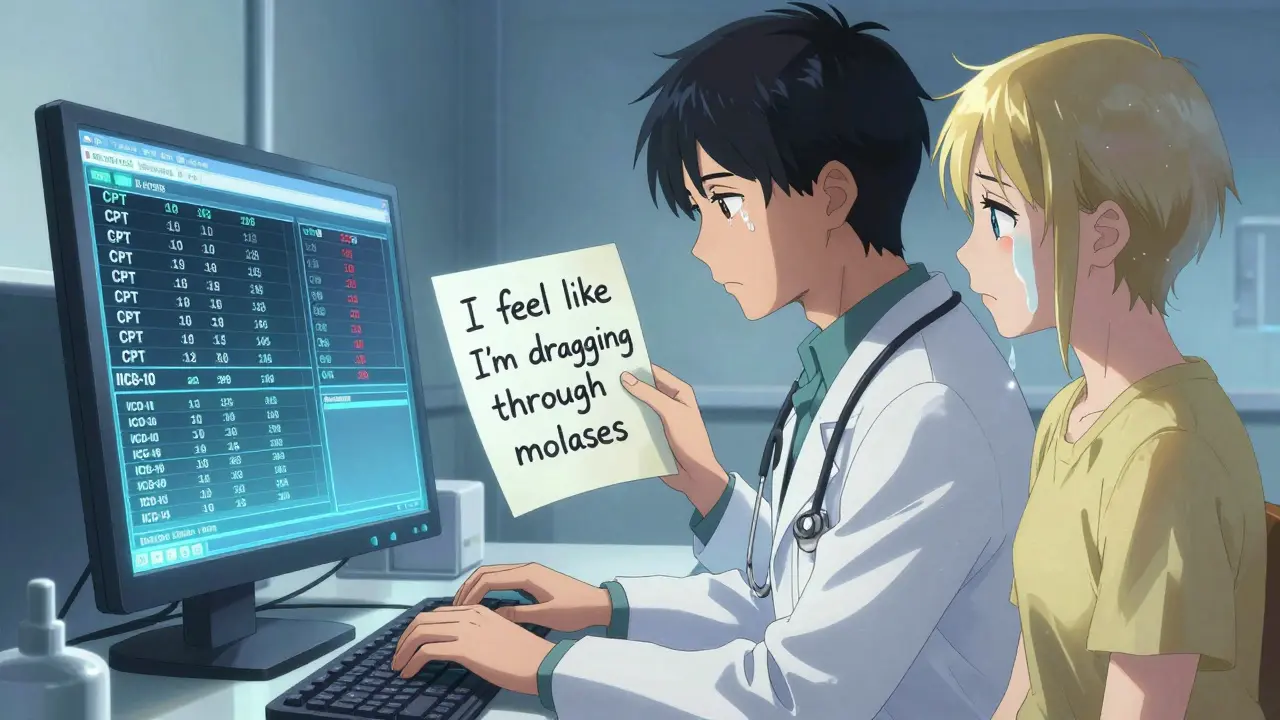
- "I feel like I’m dragging through molasses."
- "My legs hurt when I walk, but I don’t know why."
- "I take the white pill twice a day, but it makes me sick."
These aren’t vague complaints. They’re vital clues. But when they’re not translated into the system’s language, they get lost-or worse, ignored.
What Happens When Labels Don’t Match
A 2019 study in the Journal of General Internal Medicine found that 68% of patients didn’t understand common medical terms. Here’s what they got wrong:
- 42% thought "hypertension" meant something other than high blood pressure.
- 61% didn’t know "colitis" meant inflammation of the colon.
- One patient thought "anemia" meant "I’m weak"-not that their blood couldn’t carry enough oxygen.
And it’s not just confusion. It’s fear. On PatientsLikeMe, a user named "DiabetesWarrior42" wrote: "My doctor wrote ‘poorly controlled DM’ in my chart. I thought it meant I was a bad person."
That’s not just a misunderstanding. That’s trauma. And it’s common.
According to the American Medical Association’s 2022 survey, 57% of patients felt confused by the terms in their medical records. And 32% said they avoided follow-up care because they didn’t understand what was written.
Why Providers Use This Language
Doctors aren’t trying to confuse you. They’re trapped in a system built for billing, not clarity.
Electronic health records (EHRs) were designed to make insurance claims faster and reduce paperwork. They’re optimized for efficiency, not empathy. When a doctor types "E11.9," they’re not being cold-they’re checking a box that keeps the clinic paid and the system running.
And time? There’s never enough of it. The average visit lasts just 15.7 minutes, according to the 2022 MGMA DataDive report. That’s not enough to explain ICD-10 codes, answer questions, and still document everything the system demands.
So providers use shorthand. And patients pay the price.
Who’s Trying to Fix This?
Some people are fighting to change this.
Health Information Management (HIM) professionals-certified by AHIMA-work behind the scenes to make sure your records are accurate, complete, and private. But they’re also learning to bridge the gap. They’re trained to translate clinical jargon into plain language.
Hospitals like Kaiser Permanente and Mayo Clinic started something called "Open Notes." It lets patients read their doctors’ notes right after the visit. At first, many doctors were nervous. What if patients panicked? What if they misinterpreted?
The results? A 27% drop in patient confusion. A 19% increase in people taking their meds correctly. And fewer angry calls to the front desk.
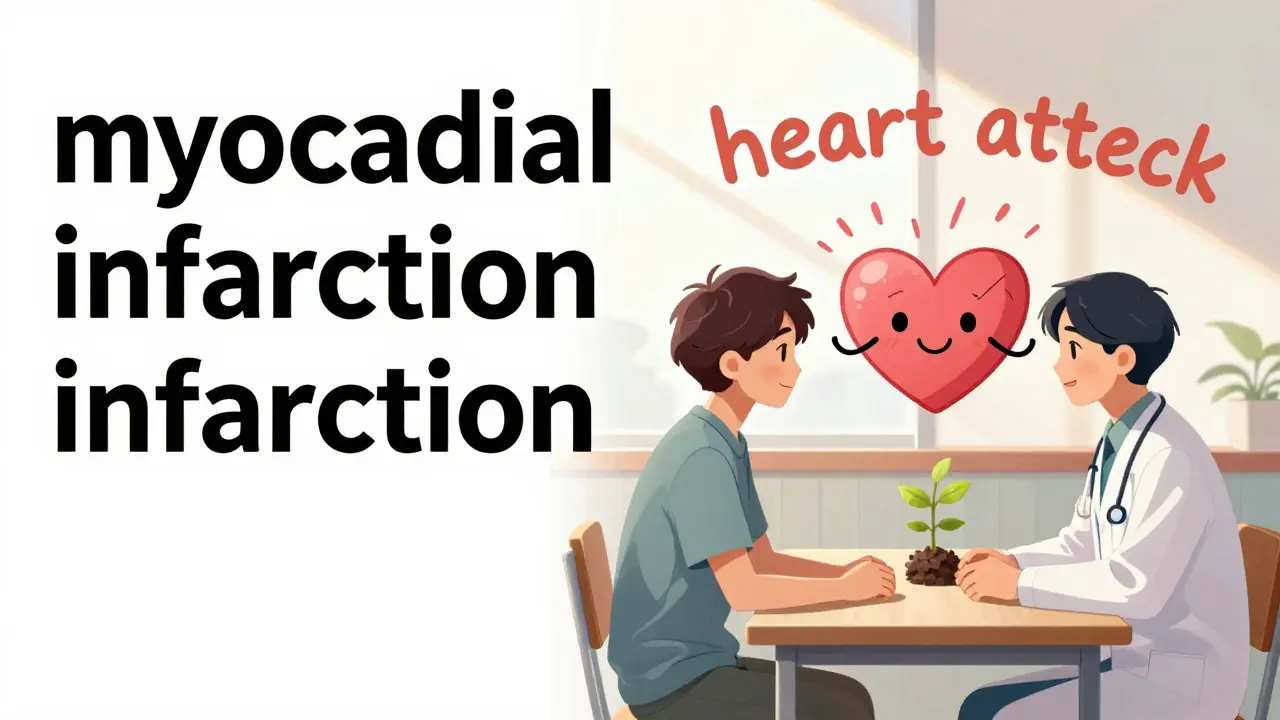
Mayo Clinic went further. They built EHR templates that automatically turn "myocardial infarction" into "heart attack" in patient-facing documents. Their pilot program cut patient confusion by 38%.
What’s Changing Now
The rules are finally catching up to reality.
In 2016, the 21st Century Cures Act said: "Patients have the right to see their own medical records." By April 2021, every provider had to give you access-no editing, no hiding. Today, 89% of U.S. hospitals let you read your notes. That’s up from just 15% in 2010.
And the World Health Organization’s ICD-11, launched in 2022, is the first major classification system to include patient-friendly descriptions alongside clinical codes. For example, "F32.0 - Mild depressive episode" now comes with a plain-language note: "You may feel sad, lose interest in things, and have trouble sleeping."
Meanwhile, the HL7 FHIR standard-used by 78% of major U.S. health systems-is letting EHRs show two versions of the same note: one for doctors, one for patients. Think of it like a split-screen: clinical terms on the left, plain language on the right.
Even AI is stepping in. Google’s Med-PaLM 2 can convert clinical notes into patient-friendly language with 72.3% accuracy. It’s not perfect yet-but it’s getting closer.
What You Can Do Right Now
You don’t have to wait for the system to fix itself. Here’s how to take control:
- Ask for plain language. After your doctor says "hypertension," say: "Can you explain that in words I can understand?" Most will be happy to help.
- Use the teach-back method. After they explain something, say: "So, just to make sure I got it-this means I need to ______, right?" This cuts miscommunication by 45%, according to a JAMA study.
- Read your notes. If your provider uses MyChart or another portal, log in after your visit. Don’t skip it. You’ll spot errors, misunderstandings, or missing details.
- Ask for a copy of your record. You have the legal right to it. If they say no, ask to speak to the HIM department. They’re the ones who manage your records.
- Write down your symptoms in your own words. Bring this to your appointment: "I feel dizzy after eating," not "I have orthostatic hypotension." Let them translate it.
What This Means for Your Health
This isn’t just about words. It’s about trust.
When you understand your diagnosis, you’re more likely to take your medicine. You’re more likely to show up for follow-ups. You’re less likely to panic when you see a strange term in your chart.
And when providers start seeing you as a person-not just a code-they’re better at helping you. Studies show that when patients feel heard, their outcomes improve. Blood pressure drops. Blood sugar stabilizes. Hospital visits go down.
The gap between patient and provider language isn’t going away overnight. But it’s shrinking. And you have more power than you think to close it.
What’s Next
By 2027, experts predict 60% of electronic health records will automatically translate clinical terms into plain language. That’s huge. But it won’t replace the human conversation. It will just make it easier.
The goal isn’t to make doctors stop using codes. It’s to make sure you understand what those codes mean. Because your health isn’t a code. It’s your life.
Why do doctors use medical codes instead of plain language?
Doctors use medical codes because they’re required by insurance companies, Medicare, and electronic health record systems for billing and legal documentation. These codes (like ICD-10 and CPT) are standardized so every provider, hospital, and insurer uses the same language. But they’re not meant for patients. They’re meant for systems.
Can I ask my doctor to explain my diagnosis in simple terms?
Yes, absolutely. You have the right to understand your health. Say something like, "I want to make sure I understand this correctly-can you explain it like I’m not a doctor?" Most providers appreciate the question and will take the time to clarify.
What should I do if I don’t understand my medical records?
Don’t guess. Don’t ignore it. Call your provider’s office and ask to speak with a health information manager or patient educator. Many clinics have staff trained to help patients understand their records. You can also request a copy of your record and bring it to a second opinion visit.
Are patient-friendly notes becoming standard?
Yes, and fast. Thanks to the 21st Century Cures Act and tools like OpenNotes, most U.S. hospitals now let patients read their clinical notes. Many are now adding plain-language translations automatically. Kaiser Permanente, Mayo Clinic, and others have already done it-and seen better outcomes.
How does this affect my treatment?
When you understand your diagnosis and treatment plan, you’re more likely to follow it. Studies show patients who understand their records take their medications correctly, show up for appointments, and report fewer side effects. Misunderstanding medical terms is one of the top reasons for treatment failure.
Is it okay to write down my symptoms before my appointment?
Yes-it’s one of the best things you can do. Write down how you feel in your own words: "I get dizzy after standing," not "I have orthostatic hypotension." This helps your doctor connect your experience to the right medical term. It saves time and reduces mistakes.





Linda Caldwell
16 December 2025 - 17:28 PM
I used to panic every time I saw a code in my chart. Then I started asking my doc to translate. Now I feel like I’m actually in charge of my health. 🙌
Anna Giakoumakatou
17 December 2025 - 13:18 PM
Ah yes, the noble art of medical obfuscation-where clarity is sacrificed on the altar of billing compliance. How quaint. The real tragedy? Patients are expected to be fluent in bureaucratic hieroglyphics.
Donna Packard
18 December 2025 - 22:19 PM
It’s amazing how a simple phrase like 'your blood sugar is too high' can make such a difference. I wish more providers just said it plainly.
Sam Clark
20 December 2025 - 06:46 AM
The structural misalignment between clinical documentation requirements and patient comprehension is a well-documented systemic failure. The adoption of patient-facing language interfaces represents a necessary and evidence-based evolution in health communication.
Virginia Seitz
21 December 2025 - 15:25 PM
I just ask my doc to say it like I’m 5. Works every time 😊
Peter Ronai
21 December 2025 - 17:04 PM
This whole 'plain language' thing is just woke medicine. Doctors aren’t here to coddle you. If you can’t understand ICD-10, maybe you shouldn’t be on meds.
Steven Lavoie
22 December 2025 - 05:48 AM
I’ve worked in clinics for over a decade. The most effective change I’ve seen isn’t tech-it’s when providers pause, look patients in the eye, and say, 'Let me explain this without jargon.' It takes 30 seconds. It changes everything.
Michael Whitaker
23 December 2025 - 22:31 PM
I must say, as someone who has reviewed over 3,000 patient records, the lack of clinical precision in patient narratives is alarming. The notion that patients should dictate terminology is not only unscientific-it’s dangerously sentimental.
Anu radha
25 December 2025 - 04:14 AM
In my country, doctors don't explain much. But I learned to ask. Now I write down my questions before going. Small steps, but they help.
Jigar shah
26 December 2025 - 09:45 AM
FHIR and ICD-11 are promising, but implementation remains inconsistent. The real bottleneck isn’t technology-it’s workflow design. EHRs still prioritize billing over communication.
Sachin Bhorde
28 December 2025 - 01:54 AM
bro the EHRs are a nightmare. i’ve seen docs type the same note 3x just to hit all the boxes. patients ain’t dumb-they just want to know if they’re gonna be ok. stop overcomplicating it.
Naomi Lopez
28 December 2025 - 11:19 AM
Honestly, I find it ironic that we’ve built AI systems that can predict disease progression but can’t render 'hypertension' as 'high blood pressure' without a 12-step approval process.
Salome Perez
28 December 2025 - 22:43 PM
I’ve seen patients cry because they thought 'poorly controlled DM' meant they were lazy. That’s not a coding error. That’s a moral failure. The fact that Mayo and Kaiser are fixing this? That’s hope. Let’s push every clinic to follow.
Kent Peterson
29 December 2025 - 09:18 AM
This is why America’s healthcare is broken. We let bureaucrats dictate how doctors speak to patients. In Germany, they just tell you what’s wrong-no code, no fuss. We need to stop pretending tech fixes human problems.
Victoria Rogers
29 December 2025 - 14:54 PM
I don't know why people are so shocked. Doctors have always spoken in riddles. It's not about clarity-it's about control. And if you're not educated enough to decode it, maybe you shouldn't be asking questions.