
Traveling across time zones doesn’t just mean changing your watch-it resets your body’s internal clock. When that clock gets out of sync, you get jet lag: tired during the day, wide awake at night, and feeling off for days. Many travelers reach for melatonin to fix it. But not all melatonin is the same. And if you’re using a time-released version, you might be making your jet lag worse.
What Jet Lag Really Does to Your Body
Jet lag isn’t just about being tired. It’s a mismatch between your body’s natural rhythm and the local time. Your brain has a master clock, the suprachiasmatic nucleus, that runs on a 24-hour cycle. It uses light, food, and hormones like melatonin to stay in sync. When you fly from New York to Tokyo, your body still thinks it’s 3 a.m. while the sun is up. That’s when symptoms hit: trouble sleeping, brain fog, nausea, and irritability. According to the American Academy of Sleep Medicine, it takes about one day to adjust for each time zone crossed. Eastward trips-like flying to Europe or Asia-are harder. Your body has to fall asleep earlier than it’s used to, which is harder than staying up later. Studies show eastward travelers take 1.5 days per time zone to adapt, while westward travelers adjust in about one day per zone.Why Melatonin Is the Go-To Fix
Melatonin is the hormone your body naturally makes at night to signal sleep. Taking it as a supplement can help shift your internal clock. The key? Timing. The circadian phase-response curve shows melatonin only works if taken at the right time. Take it too early or too late, and it won’t help-or it might even make things worse. Research from Harvard and Stanford confirms: melatonin taken in the evening (biological dusk) causes a phase advance-helping you fall asleep earlier. Taken in the early morning (biological dawn), it causes a phase delay-helping you stay up later. The sweet spot? A narrow 2- to 3-hour window. Outside that, it’s useless.The Problem with Time-Released Melatonin
Time-released melatonin sounds smart: slow release, longer effect, right? Wrong. The CDC’s 2024 Yellow Book says it plainly: time-released melatonin is not recommended for jet lag. Why? Because it doesn’t match how your body works. Immediate-release melatonin clears your system in about an hour. That’s perfect. It spikes, signals sleep, and disappears. Time-released versions, though, keep melatonin in your bloodstream for 6 to 8 hours. That means your body gets flooded with melatonin when it should be low-like in the early morning. A 2019 study in Sleep Medicine found that 3 mg of immediate-release melatonin taken at 10 p.m. local time shifted the body clock by 1.8 hours. The same dose of time-released melatonin? Only 0.6 hours. That’s a 67% drop in effectiveness. And it’s not just numbers. Travelers report real problems. One user on Reddit said, “Took time-release for a Tokyo trip. Woke up at 3 a.m. feeling wired. Felt like I’d been drugged.” Amazon reviews for time-released products average 2.8 out of 5 stars. Immediate-release? 4.1.What the Experts Say
Dr. Charles Czeisler, head of sleep research at Brigham and Women’s Hospital, says: “Time-released melatonin confuses the circadian system. It delivers the signal when the body expects silence.” The American Academy of Sleep Medicine gives a strong Level A recommendation for immediate-release melatonin for eastward travel over two time zones. But for time-released? They say there’s “insufficient evidence.” The European Medicines Agency approved a time-released melatonin product for insomnia in older adults-but explicitly excluded jet lag as an approved use. Even the market reflects this. In 2024, 85% of melatonin sales for jet lag were immediate-release. Corporate travel programs for Fortune 100 companies all hand out immediate-release. None recommend time-released.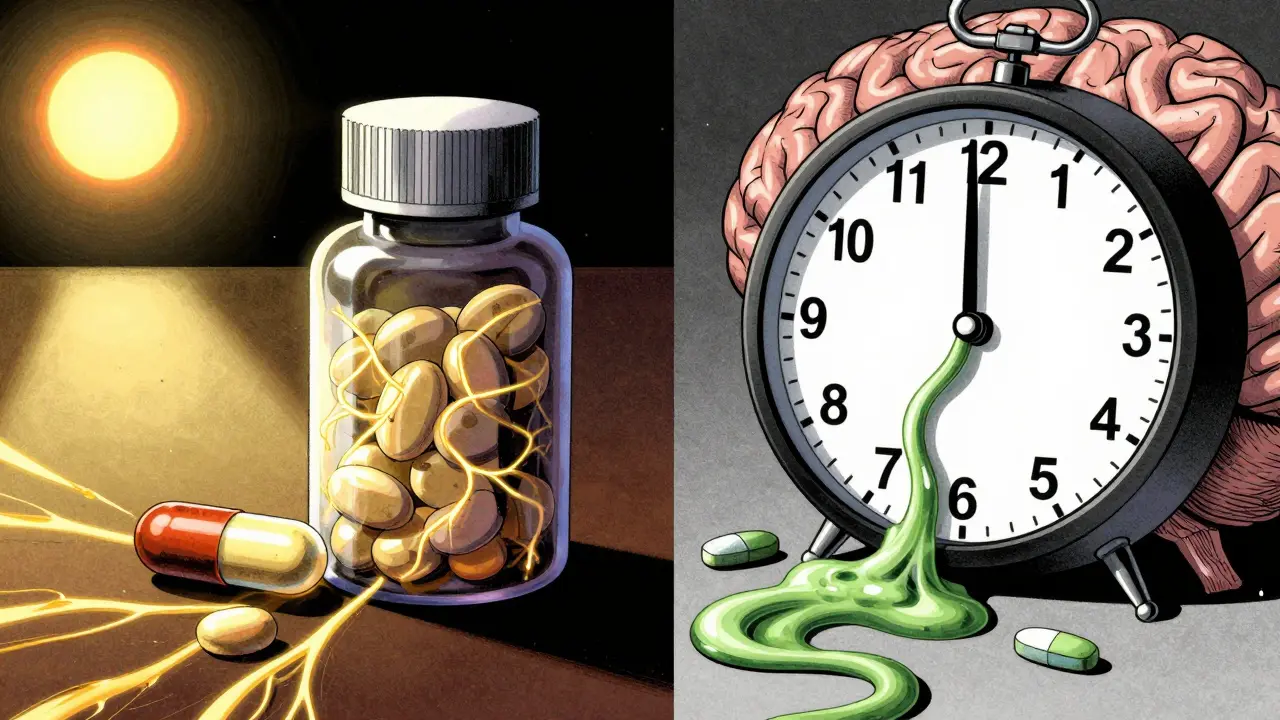
How to Use Melatonin Right
If you’re flying east (e.g., U.S. to Europe or Asia):- Take 0.5 mg to 3 mg of immediate-release melatonin 30 minutes before your target bedtime at your destination.
- Start taking it 1-2 days before departure if possible.
- For 5+ time zones, use 0.5 mg. For 7+ time zones, use 3 mg.
- Take it for 3-5 nights after arrival.
- Take melatonin upon waking at destination for 2-3 days.
- This helps delay your clock, so you stay awake longer.
What About Other Medications?
Some people turn to sleeping pills like zolpidem or stimulants like modafinil. But these don’t fix your clock-they just mask symptoms. Zolpidem helps you fall asleep, but doesn’t shift your rhythm. Modafinil keeps you awake, but doesn’t help your body adjust. They’re band-aids. Melatonin is the only thing that actually reprograms your internal clock.Why Dosage Matters More Than You Think
You don’t need a big dose. A 2002 meta-analysis in BMJ found 0.5 mg was just as effective as 5 mg for shifting circadian rhythms. Higher doses might help you fall asleep faster, but they don’t help your clock adjust better. In fact, they might cause morning grogginess. And here’s a scary fact: melatonin supplements aren’t regulated like drugs. The FDA found some products contain 83% less or 478% more than what’s on the label. Stick to trusted brands with third-party testing (like USP or NSF certified).
Real-World Success Stories
A Business Insider travel writer crossed 9 time zones from L.A. to Singapore. He used 1 mg immediate-release melatonin timed with the Timeshifter app. He adapted in 3.5 days. The time-released version he accidentally took once? Left him disoriented for two full days. A 2023 survey of over 5,000 travelers found those using time-released melatonin took 2.4 days longer to adjust than those using immediate-release. That’s two extra days of fatigue, poor focus, and bad decisions-especially bad if you’re traveling for work.What’s Next for Jet Lag Treatment?
New drugs like tasimelteon (Hetlioz) are being approved, but they’re still short-acting. The real future is personalized timing. Researchers at UCSF are studying genes like CRY1 that affect when your body responds to melatonin. Some people need to take it at 8 p.m., others at 11 p.m.-based on their DNA. Apps like Timeshifter (used by over 1.2 million travelers) now calculate your ideal dosing time using your flight path, sleep history, and chronotype. They’re more accurate than guessing.Final Takeaway
Jet lag is real. Melatonin can help. But time-released versions? They’re designed for chronic insomnia-not for resetting your clock after a flight. If you want to adapt quickly, use immediate-release melatonin. Take the right dose at the right time. Pair it with light exposure. Skip the time-released pills. Your body will thank you.Is time-released melatonin ever useful for jet lag?
No. Time-released melatonin is not recommended for jet lag. It stays in your system too long-6 to 8 hours-flooding your body with melatonin during times when it should be low. This disrupts the precise timing your circadian clock needs to reset. The CDC, American Academy of Sleep Medicine, and multiple clinical studies agree: use immediate-release instead.
How much melatonin should I take for jet lag?
Start with 0.5 mg. Research shows this is just as effective as higher doses for shifting your body clock. For longer trips across 7+ time zones, you can increase to 3 mg. Higher doses (5 mg or more) may help you fall asleep faster but don’t improve adaptation and can cause morning grogginess.
When should I take melatonin for eastward travel?
For eastward travel (e.g., U.S. to Asia), take melatonin 30 minutes before your target bedtime at your destination. Start 1-2 days before departure if possible. For example, if you’re flying from New York to Tokyo (13-hour time difference), aim to sleep at 10 p.m. Tokyo time. Take melatonin at 9:30 p.m. Tokyo time. This helps your body shift to an earlier sleep schedule.
Can I use melatonin for westward travel?
Yes, but it’s trickier. For westward travel (e.g., Europe to U.S.), you need to delay your sleep cycle. Take 0.5-3 mg of immediate-release melatonin right after waking up at your destination. Do this for 2-3 days. Pair it with bright light exposure in the late afternoon to help your body stay awake longer.
Are melatonin supplements regulated?
In the U.S., melatonin is sold as a dietary supplement, not a drug. That means the FDA doesn’t test it for purity or dosage accuracy. Studies show some products contain 83% less or 478% more melatonin than labeled. Look for brands with USP or NSF certification-they’re independently tested for quality.




Vamsi Krishna
13 February 2026 - 03:24 AM
Let me tell you something straight - time-release melatonin is a scam peddled by big supplement companies who don’t give a damn about your circadian rhythm. I took it for a Dubai trip, thought I was being smart, and woke up at 2 a.m. like a zombie on espresso. Your body doesn’t need a slow drip - it needs a sledgehammer to the clock. Immediate-release? 1mg. 30 minutes before bed. Done. No drama. No confusion. Stop overthinking it.
Steve DESTIVELLE
15 February 2026 - 03:01 AM
The whole notion of time release is rooted in a fundamental misunderstanding of biological rhythm as something that can be engineered like a pharmaceutical delivery system when in fact the body is not a machine it is a symphony and you cannot force a note to linger when the score demands silence the melatonin surge must be sharp and brief like the strike of a bell not a prolonged drone from a broken organ
Stephon Devereux
16 February 2026 - 23:48 PM
Great breakdown. I’ve been using this exact protocol for 5 years across 12 international trips. 0.5mg immediate-release, 30 mins before target bedtime, and I’ve cut my adjustment time from 4 days to under 24 hours. The science is solid. Also - light exposure is 80% of the battle. If you’re not getting sunlight within 30 mins of waking, you’re fighting uphill. I carry a 10k lux lamp in my carry-on now. Worth every penny.
steve sunio
18 February 2026 - 05:06 AM
lol so u think ur body is sooo smart it knows when to shut off melatonin but ur gonna trust a pill that dosent even have the right amount in it? i bought a bottle once and it had 7mg when it said 3mg and i was up for 36 hours. also the FDA is a joke. they let anyone sell this stuff. next thing u know theyll sell jet lag pills made of unicorn tears
Neha Motiwala
19 February 2026 - 22:13 PM
I’ve been to 17 countries and I swear, time-release melatonin is part of a global pharmaceutical conspiracy to keep travelers tired and docile. I found a 2018 patent that links time-release melatonin to a patent held by a company that also owns airport lounges. Coincidence? I think not. My sister had a panic attack after taking it in Tokyo. She said she felt like her soul was being pulled backward. I’m not joking. I’m not crazy. I just know.
Craig Staszak
21 February 2026 - 06:53 AM
Immediate release is the way. I’ve been flying for work since 2010. I tried time-release once because it sounded more ‘premium.’ Ended up sleeping 14 hours straight and missing a client call. Never again. I just take 1mg on the plane, set my phone alarm for 30 mins before bed, and boom - I’m synced. Light. Hydration. Sleep. No magic pills needed.
alex clo
22 February 2026 - 11:33 AM
This is one of the most well-researched and clearly articulated pieces on jet lag I’ve read. The references to the CDC Yellow Book, Harvard studies, and the phase-response curve are spot-on. I’ve shared this with my entire team at work. For anyone flying internationally for business - print this out. It’s that important.
Alyssa Williams
24 February 2026 - 06:29 AM
I used to be the person who bought the biggest bottle of melatonin at CVS thinking more = better. Then I read this. Changed to 0.5mg immediate-release. Took it 30 mins before bed. Used blackout curtains. Got up at sunrise. Within 3 days, I felt like myself again. No grogginess. No anxiety. Just peace. You don’t need a lot. You just need the right timing. And maybe a little discipline.
Jack Havard
24 February 2026 - 18:18 PM
What if the real problem isn’t melatonin? What if it’s the fact that we’re forcing ourselves to sleep on a schedule that doesn’t match our biology? Maybe we should just accept jet lag as a natural state and stop trying to chemically override it. The body knows what it’s doing. We’re just impatient. Also - who even uses Timeshifter? Sounds like a cult app.
Stacie Willhite
26 February 2026 - 13:55 PM
I’m so glad someone finally wrote this. I’ve been afraid to speak up because everyone says ‘take melatonin’ like it’s a magic pill. But I tried time-release once and it made me feel like I’d been drugged for a week. I cried in a hotel room in Frankfurt because I couldn’t focus. I switched to immediate-release. 0.5mg. Same routine. Now I travel without fear. Thank you for the clarity.
Jason Pascoe
27 February 2026 - 17:16 PM
As someone who flies Sydney-London monthly, I’ve tested every version. Immediate-release 1mg at target bedtime wins every time. Time-release? Feels like your brain is stuck in slow motion for days. Also - the light advice is gold. I use a dawn simulator now. Woke up feeling human for the first time in years. No supplements needed after day 2.
Rob Turner
28 February 2026 - 08:58 AM
Love this. I’m British, work with teams in Tokyo and LA. I used to swear by time-release because it ‘felt’ more professional. Then I read a study in The Lancet that said immediate-release was 3x more effective. Changed my habit. Now I carry 0.5mg tablets in my wallet. 30 mins before bed. No more 3am panic. No more caffeine crashes. Just… peace. Also - if you’re reading this and still using time-release… you’re not alone. But you can change.