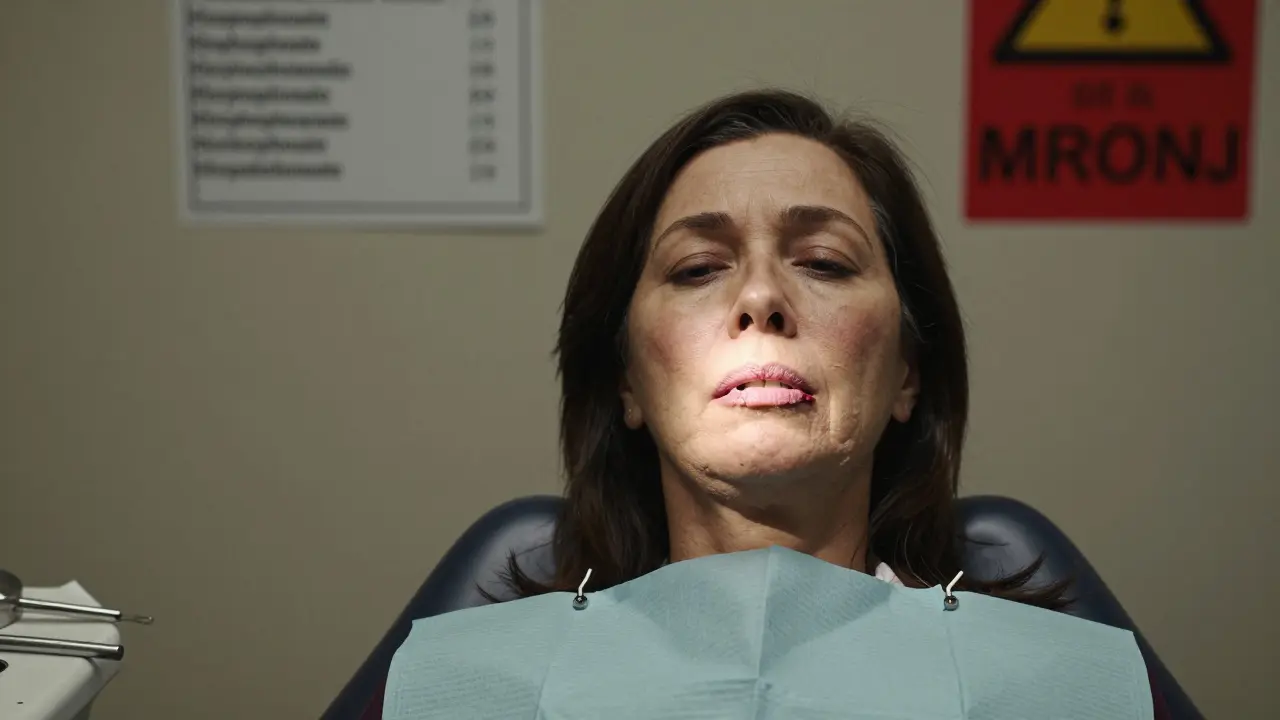
When you're diagnosed with osteoporosis, your doctor likely talks about reducing fracture risk - and for good reason. One in two women over 50 will break a bone due to weak bones. Bisphosphonates like alendronate (Fosamax), risedronate (Actonel), and ibandronate (Boniva) have been the go-to treatment for decades because they work. They cut hip fracture risk by over 50% and spine fractures by nearly half. But somewhere in the fine print, you might hear about a rare but scary side effect: medication-related osteonecrosis of the jaw, or MRONJ.
What Exactly Is MRONJ?
MRONJ isn't just a mouth sore. It’s when bone in your jaw becomes exposed and doesn’t heal for more than eight weeks. You might notice it after a tooth extraction, a denture adjustment, or even a routine cleaning. The bone sticks out through the gum, sometimes with pain, swelling, or infection. It doesn’t happen overnight. It takes months - sometimes years - to show up.
This isn’t random. It happens because bisphosphonates lock themselves into your bones and stay there - for over 10 years in some cases. They stop bone breakdown by killing off the cells (osteoclasts) that normally clean out old bone. That’s great for keeping your spine and hips strong. But your jaw? It’s different. It remodels bone 10 times faster than your thigh bone. That means it’s more active, more exposed to bacteria from your mouth, and more vulnerable when healing gets blocked.
The Real Risk: How Common Is It?
Let’s get real. If you’re taking an oral bisphosphonate for osteoporosis, your chance of getting MRONJ is about 0.7 in 100,000 people per year. That’s less than one case in a million. For comparison, you’re more likely to be struck by lightning than develop this condition.
But here’s where it gets confusing: some people hear horror stories. A woman on a patient forum spent 18 months dealing with exposed bone after a cleaning. Another guy had 22 years on Fosamax and never had an issue. Both are true. The problem isn’t the drug - it’s the combination of factors.
Studies show that 63% of MRONJ cases in osteoporosis patients follow a dental procedure - usually an extraction. If you already have gum disease, loose teeth, or an infection before starting treatment, your risk goes up. The medication doesn’t cause it. It just makes healing harder.
And here’s the twist: intravenous bisphosphonates - like zoledronic acid (Reclast) - carry a higher risk than pills. Why? Because they deliver a much stronger dose directly into your bloodstream. Cancer patients on high-dose IV versions have a 3-16% risk. But for osteoporosis? That same drug, given once a year at a lower dose, still keeps the risk under 1 in 100,000.
Bisphosphonates vs. Denosumab: Which Is Safer?
Denosumab (Prolia) is the newer option. It’s not a bisphosphonate - it’s a monoclonal antibody that also stops bone loss. It works just as well at preventing fractures. But here’s the catch: studies show it carries 1.7 to 2.5 times the risk of MRONJ compared to oral bisphosphonates.
That doesn’t mean it’s unsafe. It just means if you’re choosing between treatments, your dentist and doctor need to weigh the numbers. Denosumab requires injections every six months. If you miss one, bone loss can rebound fast. Bisphosphonates, once taken, stick around for years. That’s why stopping them suddenly - even to avoid MRONJ - can be dangerous.
A 2024 study in Nature Communications found that if you stop IV zoledronate for more than a year, your MRONJ risk drops by 82%. But your fracture risk jumps by 28%. That’s not a trade-off most patients can afford.
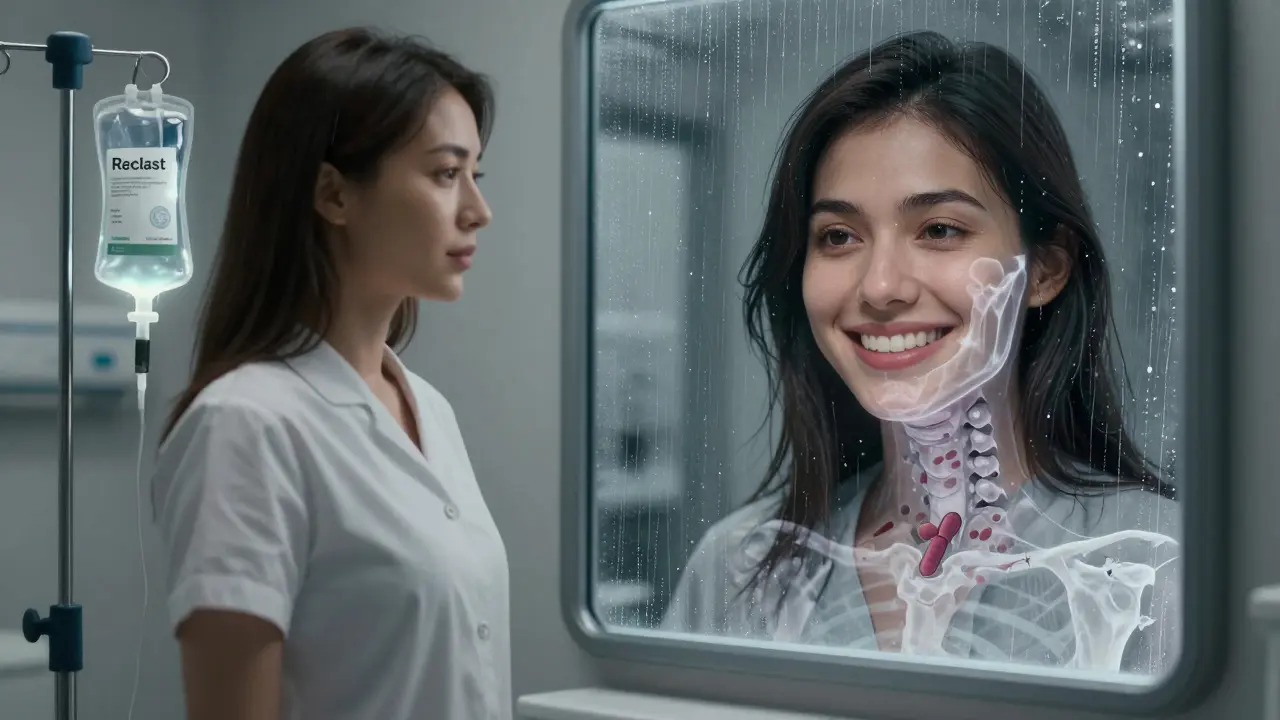
What Should You Do Before Starting Treatment?
The best way to avoid MRONJ is to start with a healthy mouth. The American Dental Association and the American Association of Oral and Maxillofacial Surgeons both say: get a full dental exam before you begin bisphosphonates. Fix cavities. Remove loose teeth. Treat gum disease. Don’t wait until you’re on the drug.
If you’re already taking a bisphosphonate and need dental work, don’t panic. Most routine cleanings, fillings, and crowns are safe. The big red flag is extraction or surgery. Talk to your dentist and your doctor together. They might recommend a short drug holiday - especially if you’ve been on IV therapy for 3-4 years. But don’t stop your medication on your own. That could lead to a spine fracture.
Signs to Watch For
MRONJ doesn’t always hurt at first. In fact, 35% of cases start with no symptoms - just exposed bone. Here’s what to look for:
- Bone sticking out through the gum after a tooth is pulled
- Pain or swelling in the jaw that doesn’t go away
- Loose teeth with no clear reason
- Pus or bad taste in the mouth that won’t clear up
- Delayed healing after dental work
If you notice any of these, see your dentist immediately. Early-stage MRONJ can often be managed with antibiotics, mouth rinses, and avoiding further trauma. Later stages may need surgery - but that’s rare in osteoporosis patients.
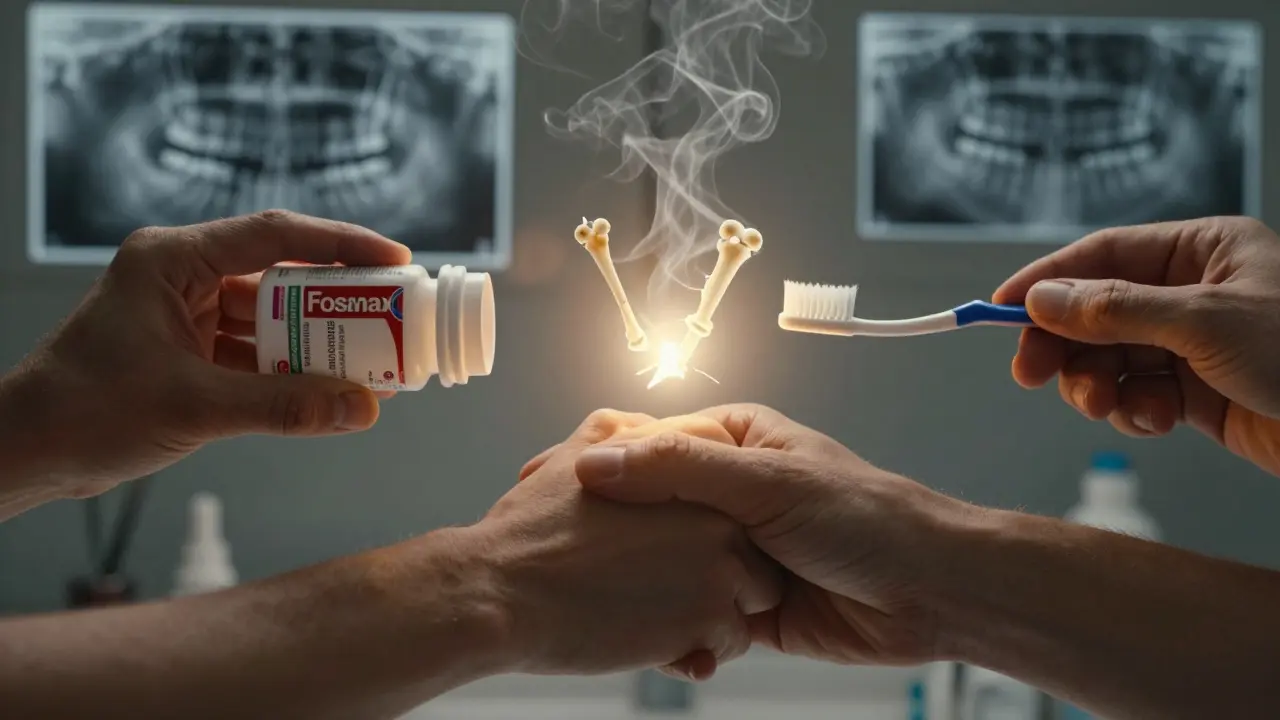
Why Do Dentists Get Nervous?
Many dentists are scared of MRONJ - not because it’s common, but because it’s serious. Some refuse to extract teeth in patients on bisphosphonates. Others over-test, over-wait, or over-treat. That’s not helpful. It leads to delays in care, more pain, and sometimes worse outcomes.
Doctors need to know the real numbers. A 2023 survey found 87% of osteoporosis patients worry about MRONJ before dental work. But only 2.3% ever experience it. That fear is driving people away from needed care. One patient on HealthUnlocked said, “My dentist refused to fix my broken crown because I take Fosamax. I ended up with an abscess.”
The truth? Most dentists don’t have access to the latest research. They’re working off old guidelines or fear-based training. That’s changing. The ADA is updating its recommendations for 2025 to include data on how long you’ve been off the drug - called “time since last dose.” That will help dentists make smarter decisions.
What’s the Bottom Line?
If you have osteoporosis, the risk of breaking a hip or spine is far greater than the risk of jaw necrosis. Bisphosphonates save lives. They keep people walking, independent, and out of the hospital. The 11-year data from the Fracture Intervention Trial shows alendronate reduces hip fracture risk by 55%. That’s not a small win.
MRONJ is real. But it’s rare. And it’s preventable. You don’t need to avoid dental care. You need to be prepared. Get your mouth checked before starting treatment. Keep your gums healthy. Tell your dentist what you’re taking. Don’t skip your annual cleanings. And never stop your medication without talking to your doctor.
The future is coming. Researchers are testing blood and urine markers to find who’s most at risk for MRONJ. In a few years, we might be able to say: “You’re low risk - keep going.” Or: “You’re high risk - let’s switch to something else.” Until then, the balance is clear: protect your bones, care for your mouth, and trust the science.



Tom Swinton
5 January 2026 - 17:54 PM
Look, I get it - bisphosphonates are scary because of the jaw thing, but let’s be real: if you’re 65 and have osteoporosis, your hip breaking is way more likely than your jaw turning into a horror movie scene. I’ve been on Fosamax for eight years, had two root canals, and zero issues. My dentist didn’t even blink when I told him I was on it. He just said, ‘Keep your gums clean, don’t wait until you’re in pain to come in.’ That’s it. The fear is way out of proportion to the risk. You’re more likely to get hit by a vending machine than develop MRONJ - and vending machines are way more common than osteoporosis meds.
Also, people who say ‘I know someone who got it’ - yeah, that’s anecdotal noise. The data says one in a million. That’s not a red flag; that’s a whisper. Stop letting dental fear keep you from protecting your spine. I’ve seen grandmas on these meds walk into church on their own. I’ve seen others who skipped them end up in a wheelchair. Pick the side that lets you keep living.
And for the love of all that’s holy, don’t stop your meds because some Reddit post scared you. Talk to your doctor. Get a dental checkup. Do the math. Then live your life.
Also, if your dentist refuses to do a crown because you’re on bisphosphonates? Find a new dentist. That’s not care - that’s fear-based malpractice.
Stay strong. Stay mobile. Stay on your meds - but brush like your life depends on it. Because it does.
Vinayak Naik
5 January 2026 - 21:16 PM
bro i was on actonel for 3 years and my dentist was like ‘ohhh uhhhh we shud wait’ and i was like ‘dude i just wanna fix this cavity not survive a zombie apocalpyse’
turned out my jaw was fine, the crown lasted 5 years, and i still walk like a man. dont let fear turn you into a dental refugee. get it done. clean your mouth. take your pill. life goes on.
Cam Jane
6 January 2026 - 17:56 PM
My mom’s on Prolia. She’s 72. Had a root canal last year. No issues. Dentist knew exactly what to do - no drama, no delays. The key? Communication. Tell your dentist. Tell your doctor. Let them work together. It’s not rocket science.
Also - if you’re scared of MRONJ, ask your doctor for a bone density scan. If your T-score is -3.2, the jaw risk is irrelevant. You’re one fall away from a hip fracture. That’s the real enemy. Don’t let fear of a 0.0007% side effect blind you to the 50% fracture reduction.
And if your dentist panics? Find one who reads journals. Or at least Google. This isn’t 2010 anymore. Guidelines changed. We know more now. You’re not a lab rat. You’re a person who deserves care - not avoidance.
Dana Termini
7 January 2026 - 22:02 PM
I appreciate how balanced this post is. Too many articles either demonize bisphosphonates or treat them like magic bullets. The truth is always in the middle - and this nails it. The data on fracture prevention is overwhelming. The risk of MRONJ is real but statistically negligible for oral users. The bigger problem is the fear-driven delays in dental care, which actually increase overall harm. Doctors and dentists need better education on this. Patients need reassurance, not scare tactics. Thank you for writing this with nuance.
Wesley Pereira
8 January 2026 - 11:28 AM
Let me get this straight - you’re telling me I can’t get a tooth pulled because I took a pill that’s still hanging out in my bones like a ghost from 2012? That’s not medicine. That’s medieval. ‘Oh, you’re on bisphosphonates? Sorry, we can’t touch that. Maybe try chewing on a stick?’
And Denosumab? Oh, it’s ‘1.7x riskier’? Cool. So now we’re playing ‘which drug is the lesser evil’ like it’s a game of Russian roulette with dental floss? Meanwhile, my grandma’s spine is collapsing because she stopped her meds after some guy on YouTube said ‘avoid all drugs.’
Here’s the real jargon: ‘risk-benefit analysis.’ You want to live independently? Keep the pills. You want to live in fear of your own mouth? Skip the meds and pray your hip holds up. Either way, stop letting dentists play scaredy-cat with your health. They’re not oncologists. They’re not even radiologists. They’re tooth mechanics. Let them fix teeth.
Also - ‘drug holiday’? Sounds like a spa package. But if you’re on IV zoledronate and you’re not getting a bone scan every 18 months, you’re not managing - you’re gambling.
Amy Le
9 January 2026 - 10:12 AM
Oh great. Another ‘trust the science’ lecture from someone who thinks ‘peer-reviewed’ means ‘I read it once on a medical blog.’
Let’s not forget that bisphosphonates were pushed by Big Pharma for decades - same way they sold hormone replacement therapy, then pulled it when the data turned. Now they’re telling us ‘it’s safe’ because the risk is ‘rare.’ But rare doesn’t mean ‘not real.’ And if you’re the one in a million? Your jaw is rotting. Your life is ruined. Your dentist won’t touch you. Your insurance won’t cover the surgery. And now you’re stuck with a hole in your face because ‘the stats say you’re fine.’
Also - why are we still using drugs that stay in your bones for 10+ years? That’s not treatment. That’s chemical imprisonment. We don’t do that with anything else. Why bones? Because we haven’t found a better way yet. But that doesn’t mean we should pretend it’s harmless.
And don’t even get me started on Denosumab. Six-month injections? What is this, 2025 or 2045? We’re treating osteoporosis like it’s diabetes now. Inject every 180 days or your bones turn to dust. That’s not medicine - that’s corporate dependency.
Maybe we should stop treating bones like they’re Lego blocks and start asking why so many people are breaking them in the first place. Vitamin D? Protein? Movement? Oh wait - those don’t come in a pill with a 20% profit margin.
Pavan Vora
10 January 2026 - 05:18 AM
India mein, bhai, koi bhi dentist pehle hi bol deta hai - ‘bhai, aapka jaw ka X-ray karo, phir hi hum karenge extraction.’
My uncle took alendronate for 5 years - never had problem. But he used to rinse with salt water every night, avoided soda, brushed twice. Simple. No drama. No panic. He’s 81 now, walks with a stick, but his jaw? Perfect.
Here’s the truth - it’s not the drug. It’s the mouth. If your gums are bad, your teeth are loose, and you drink Coke like water - no pill in the world will save you. Fix the mouth first. Then take the pill. Simple.
Also, people in US think ‘dental care’ means ‘get a crown and go.’ Here? We know - if you’re old, your mouth is your first sign of health. You take care of your teeth, you take care of your body. Simple logic.
And yes, I misspelled ‘bhai’ - but I didn’t miss the point.
Stuart Shield
10 January 2026 - 12:24 PM
I used to work in a dental clinic in London. We had a patient on Fosamax who needed a molar pulled. We called her rheumatologist. He said, ‘Go ahead. She’s been on it for 2 years. No history of periodontal disease. Just use antibiotics prophylactically.’ We did. No complications.
Most of the fear around MRONJ comes from people who’ve never seen a case. The ones who have? They’re the ones who say, ‘Yeah, it happened - but only when the patient had advanced gum disease, didn’t rinse, and waited until their jaw was half-dead to say anything.’
It’s not the drug. It’s the delay. It’s the silence. It’s the panic. It’s the dentist who says ‘no’ because they’re scared of being sued, not because they’re being careful.
And if you’re worried about long-term bone retention? You’re not alone. But the alternative - fracture, hospitalization, loss of independence - is far worse. We treat cancer with chemo that wrecks your immune system. We give blood thinners that can kill you if you cut yourself. We accept risk because the benefit outweighs it.
Why is this different? Because we’re scared of a mouth? That’s not logic. That’s cultural bias.
Take the pill. Brush your teeth. See your dentist. Don’t let fear rewrite your biology.
Gabrielle Panchev
11 January 2026 - 21:55 PM
Oh, so now we’re supposed to believe the ‘1 in a million’ statistic because some study says so? But when it happened to my neighbor’s sister’s yoga instructor, it took three surgeries, a titanium plate, and she lost half her jaw - and now she can’t eat solid food. So what? She’s just the ‘one’?
And why is it always ‘trust the science’? Science changed its mind about trans fats, about estrogen, about aspirin for everyone - why should we trust this now?
Also, why is Denosumab ‘riskier’? Because it’s newer? Or because it’s more profitable? And why is ‘drug holiday’ even a thing? Why are we treating bones like they’re a prison sentence?
And what about the people who get MRONJ from a simple cleaning? No extraction. No trauma. Just… exposure. How does that fit into your neat little ‘dental procedure’ narrative?
And why are we still using drugs that last 10 years? That’s not medicine - that’s a chemical landmine. You take it once, and now you’re stuck with it for life. No recall. No opt-out. Just… hope you don’t need a tooth pulled.
Maybe the real problem isn’t the drug - it’s that we’ve outsourced our health to a system that profits from lifelong dependency. And now we’re told to just ‘trust the data’ - while the data is written by the same people who sell the pills.
Don’t get me wrong - I’m not saying don’t take them. I’m saying don’t stop asking questions. And don’t let anyone tell you your fear is irrational when your body is the one that has to live with the consequences.
Cam Jane
11 January 2026 - 22:30 PM
Tom, you’re right - fear is the real enemy. But Gabrielle raises a point: we shouldn’t just accept ‘trust the science’ as a blanket answer. The science should be transparent, and patients should be empowered to ask, ‘What’s the long-term cost?’
My mom’s doctor gave her a printed sheet with the MRONJ stats - 0.0007% - and said, ‘You’re more likely to die from a fall than this.’ That helped. But what if she’d asked, ‘What happens if I need a tooth pulled in 7 years?’ He didn’t have a good answer. That’s the gap.
So yes - take the pill. But also demand better communication. Better follow-up. Better guidelines. Not just ‘don’t panic’ - but ‘here’s exactly what to watch for, and who to call.’
Science isn’t perfect. But informed patients? That’s the real breakthrough.