Every pill, syrup, or patch you take comes with a label. But most people skim it like a receipt-quick glance, toss it, done. That’s dangerous. Medication labels aren’t just paperwork. They’re your first and most important line of defense against overdose, dangerous interactions, and avoidable hospital visits. The FDA estimates that medication errors cause over 1.5 million preventable health problems each year in the U.S. And half of those? They happen because someone didn’t understand the label.
What’s on a Prescription Label?
If you got your medicine from a pharmacy, the label has specific sections that follow strict federal rules. You’ll see:- Your full name
- The exact name of the drug (both brand and generic)
- Strength and form (like 500mg tablet or 10mg/mL liquid)
- How much to take and how often (the dosage)
- How to take it (with food? at bedtime? by mouth? by injection?)
- How many pills or how much liquid to dispense
- Expiration date
- Pharmacy name and phone number
- Prescriber’s name
- Refill information
But the most critical part? Dosage and directions. This tells you not just how much, but when, how, and for how long. For example: "Take one tablet by mouth every 8 hours for 7 days." That means three times a day-every 8 hours, not just whenever you remember. Missing a dose? Taking extra? Both can be risky.
Some labels include special warnings. Like: "Do not take with alcohol." Or: "May cause drowsiness. Do not drive." Or: "Take with food to avoid stomach upset." These aren’t suggestions. They’re safety rules built on real harm. Skip them, and you could end up in the ER.
What’s on an Over-the-Counter (OTC) Label?
OTC meds-like Tylenol, ibuprofen, or cold syrup-follow a standardized format called "Drug Facts." It’s designed to be easy to read. Here’s what you’ll find:- Active Ingredients: The medicine that actually works. This is where you find the amount per dose. For example: "Acetaminophen 325 mg." If you’re taking more than one OTC product, check this section. Many cold medicines also contain acetaminophen. Taking two at once? You could overdose.
- Purpose: What the medicine does. "Pain reliever," "fever reducer," "antihistamine." Helps you know if it’s right for your symptoms.
- Uses: What it treats. "Relieves headache, minor aches, fever." Don’t use it for something not listed unless your doctor says so.
- Warnings: The most ignored part. This tells you who shouldn’t take it (pregnant women, people with liver disease), what to avoid (alcohol, other meds), and signs of trouble (rash, nausea, trouble breathing). 47% of people skip this section. That’s a gamble you can’t afford.
- Dosage: Exactly how much to take and how often. "Adults: 1 tablet every 4 to 6 hours." Never exceed the max daily dose. For acetaminophen? That’s 3,000-4,000 mg per day depending on your health. More than that? Liver damage.
- Other Information: Storage tips. Like: "Keep at room temperature. Protect from moisture."
- Inactive Ingredients: Fillers, dyes, flavors. Important if you have allergies.
- Expiration Date: Don’t use after this date. Medicines lose strength. Some become unsafe.
Understanding Liquid Medication Dosage
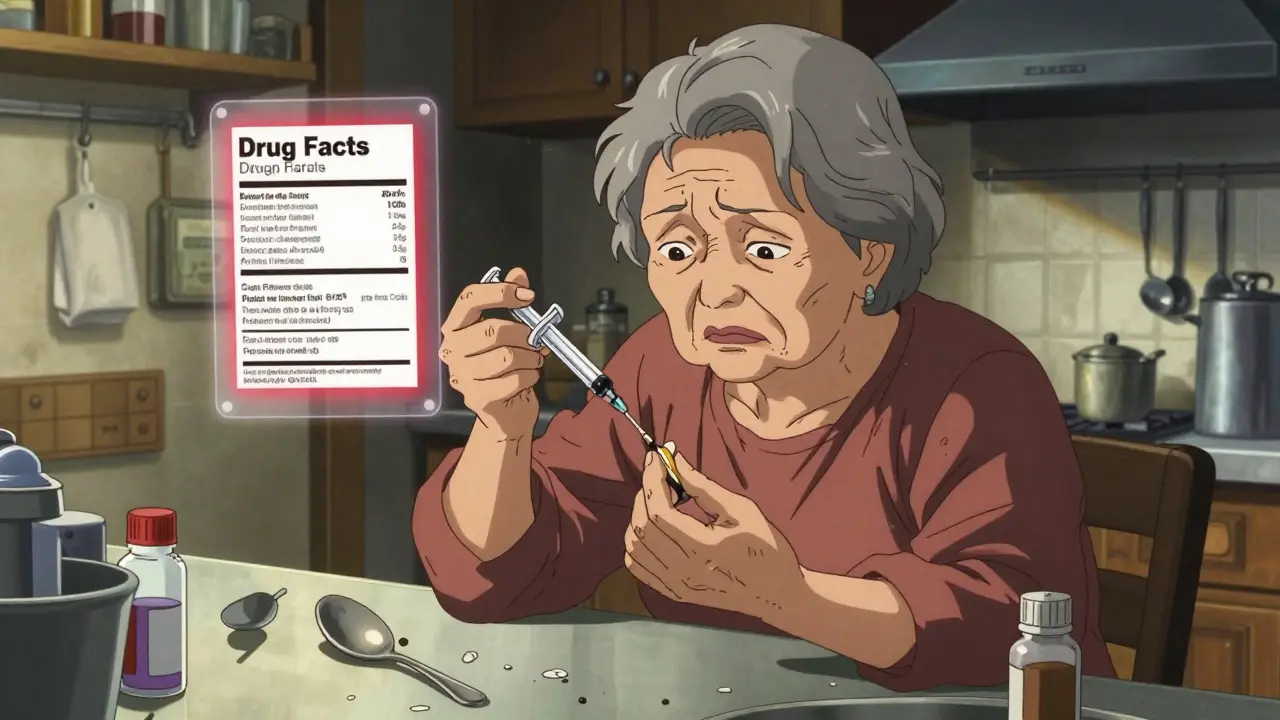
Liquid medicines are the most dangerous to get wrong. Why? Because you’re measuring. And most people don’t know how.A label might say: "250 mg per 5 mL." That means every 5 milliliters (one teaspoon) has 250 mg of the drug. If your doctor says to give 500 mg, you need two teaspoons-not "a little more than one." But here’s the trap: people use kitchen spoons. A regular teaspoon holds anywhere from 2.5 mL to 7.3 mL. That’s a 200% variation. One spoon might give you half the dose. Another might give you double.
Always use the tool that comes with the medicine: an oral syringe, dosing cup, or dropper marked in mL. Never use a kitchen spoon. If the tool is missing, ask the pharmacist for one. They’ll give it to you free.
And don’t guess concentrations. If the label says "100 mg per 5 mL," and you need 150 mg, you’re not doing "one and a half teaspoons." You’re doing 7.5 mL. Use the syringe. Measure it. Don’t eyeball it.
Special Cases: Kids, Elderly, and Chronic Conditions
Children’s doses are almost always based on weight-not age. A 20-pound baby and a 40-pound toddler need different amounts, even if they’re both 2 years old. Always check the label for weight-based dosing charts. If it’s not there, ask your pharmacist or doctor. Never use adult medicine for a child unless instructed.For older adults, kidney and liver function often slow down. That means medicines stay in the body longer. Labels for seniors might say: "Reduce dose for patients with kidney impairment." If you or a loved one has kidney disease, diabetes, or heart failure, this matters. The wrong dose can build up and cause confusion, falls, or organ damage.
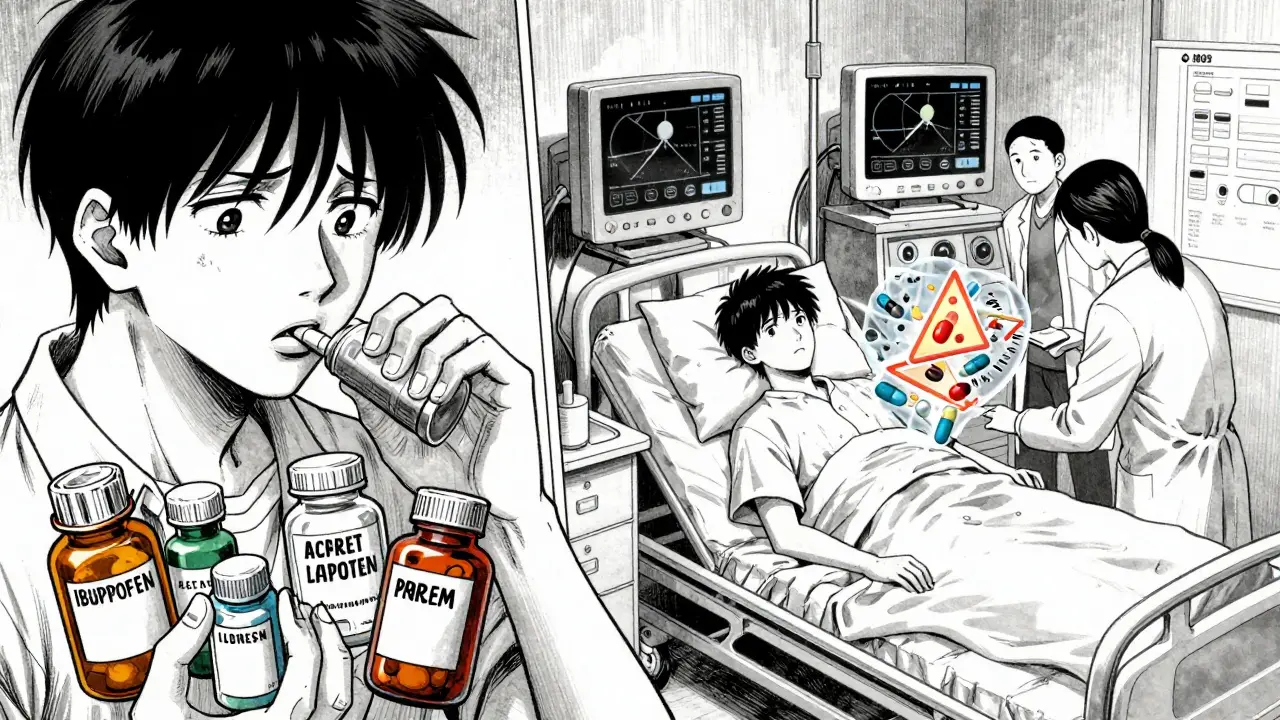
People on multiple medications are at the highest risk. One pill might be for blood pressure. Another for pain. A third for sleep. All three might contain acetaminophen. Or all might make you dizzy. The label for each one must be read separately. A 2022 study found that 27% of emergency visits for medication errors involved people taking two or more OTC drugs with the same active ingredient. They didn’t realize they were doubling up.
The Five Rights of Safe Medication Use
Nurses use a simple checklist called the "Five Rights" to avoid errors. You should too:- Right Patient: Is this medicine for you? Check your name on the label.
- Right Drug: Does it match what your doctor prescribed? Generic? Brand? Same thing? Double-check.
- Right Dose: Does the amount match what your doctor said? 10 mg? Not 100 mg?
- Right Route: Is it meant to be swallowed? Applied to skin? Inhaled? Injected? Never change the route.
- Right Time: Is it supposed to be taken with food? At night? Every 6 hours? Timing affects how well it works and how safe it is.
If you’re not sure about any of these, stop. Call your pharmacist. Don’t guess. Don’t assume.
What You’re Not Seeing (But Should Know)
Some medicines come with separate Medication Guides. These are full papers, not just labels. They’re required for high-risk drugs like opioids, blood thinners, chemotherapy, and certain antidepressants. If you get one, read it. It explains side effects, risks, and what to do in an emergency.Also, expiration dates aren’t just suggestions. The FDA says most pills are still safe after their date-but potency drops. Liquid antibiotics? They can grow bacteria. Insulin? It stops working. Throw out expired meds. Don’t risk it.
And here’s something new: some pharmacies are starting to put QR codes on labels. Scan it with your phone, and you’ll get a video showing how to take the medicine, a dosage calculator, or even a reminder system. It’s still rare, but it’s coming. Look for the code.
What to Do If You’re Confused
If the label doesn’t make sense:- Call your pharmacist. They’re trained to explain labels. No judgment. No rush.
- Ask your doctor to write down instructions in plain language.
- Use a pill organizer with alarms. It helps you stick to the schedule.
- Bring all your meds (including OTC and supplements) to your next appointment. Let your doctor or pharmacist check for overlaps.
Don’t rely on memory. Don’t ask a friend. Don’t Google it. Labels are the official source. Everything else is guesswork.
Final Rule: When in Doubt, Don’t Take It
If you can’t explain to someone else exactly how to take the medicine-don’t take it. Not today. Not tomorrow. Not until you’ve called your pharmacy or doctor. Medication errors aren’t accidents. They’re preventable. And they happen because people didn’t ask questions.Reading the label takes 60 seconds. That’s all. But that 60 seconds could save your life-or someone else’s.

Lana Kabulova
23 January 2026 - 09:47 AM
I used to skip labels like they were junk mail-until my mom ended up in the ER because she took two different cold meds with acetaminophen and didn’t realize it. Now I read every word, even the tiny print. I mean, seriously-how is this not taught in high school? Like, we learn quadratic equations but not how not to poison ourselves with Tylenol?!
Keith Helm
25 January 2026 - 09:42 AM
Compliance with pharmaceutical labeling is a matter of public health imperative. Failure to adhere to dosage instructions constitutes a preventable medical error. The FDA data cited is statistically significant and warrants institutional intervention.
Alec Amiri
25 January 2026 - 14:01 PM
Bro. You’re telling people to read labels like they’re reading a novel? Nah. Most folks just want to feel better. If you’re taking meds and you’re confused? That’s not your fault. That’s the system’s fault. Pharmacies charge $40 for a pill bottle and then expect you to be a pharmacist? Come on. They should print it in emojis. 🚫🍺 = no alcohol. 😴 = don’t drive. 💊 = 1x a day. Simple. Done. Stop making it a quiz.
Akriti Jain
26 January 2026 - 06:28 AM
QR codes on labels? 😏 Yeah right. Next they’ll put a TikTok dance tutorial on my blood thinner. I swear, Big Pharma just wants us to scan and buy more stuff. Also, expiration dates? LMAO. My grandma’s 2018 ibuprofen still works fine. And if it makes me sleepy? Good. I need sleep. 🤓💊 #trustnoone
Hilary Miller
27 January 2026 - 00:27 AM
In India, we call this ‘dawa ka label padho’-read the medicine label. My auntie always says: ‘If you don’t know what’s in it, don’t swallow it.’ Simple. Wise. We don’t have fancy QR codes, but we have grandmas who remember every side effect. Respect.
Margaret Khaemba
28 January 2026 - 17:25 PM
OMG this is so true. I just started taking a new blood pressure med and honestly? I was scared to take it because I didn’t understand the ‘take with food’ part. So I called my pharmacist-she walked me through it on the phone, sent me a link to a video, and even told me which foods to avoid. No judgment. Just help. That’s the kind of care we need more of. Thank you for writing this.
Malik Ronquillo
29 January 2026 - 16:14 PM
Reading labels is for people who don’t trust doctors. I take what they give me. If I feel weird? That’s my body’s problem. Also, I’ve been taking OTC painkillers for 10 years. Never died. So maybe the ‘overdose’ thing is just fearmongering. 🤷♂️
Brenda King
30 January 2026 - 04:04 AM
Thank you for this. I’m a nurse and I see this every day. People think ‘it’s just a pill’-but pills are powerful. I always tell my patients: ‘If you’re not sure, don’t take it. Call us. We’re here.’ And yes, use the syringe. Never the spoon. Ever. 💙