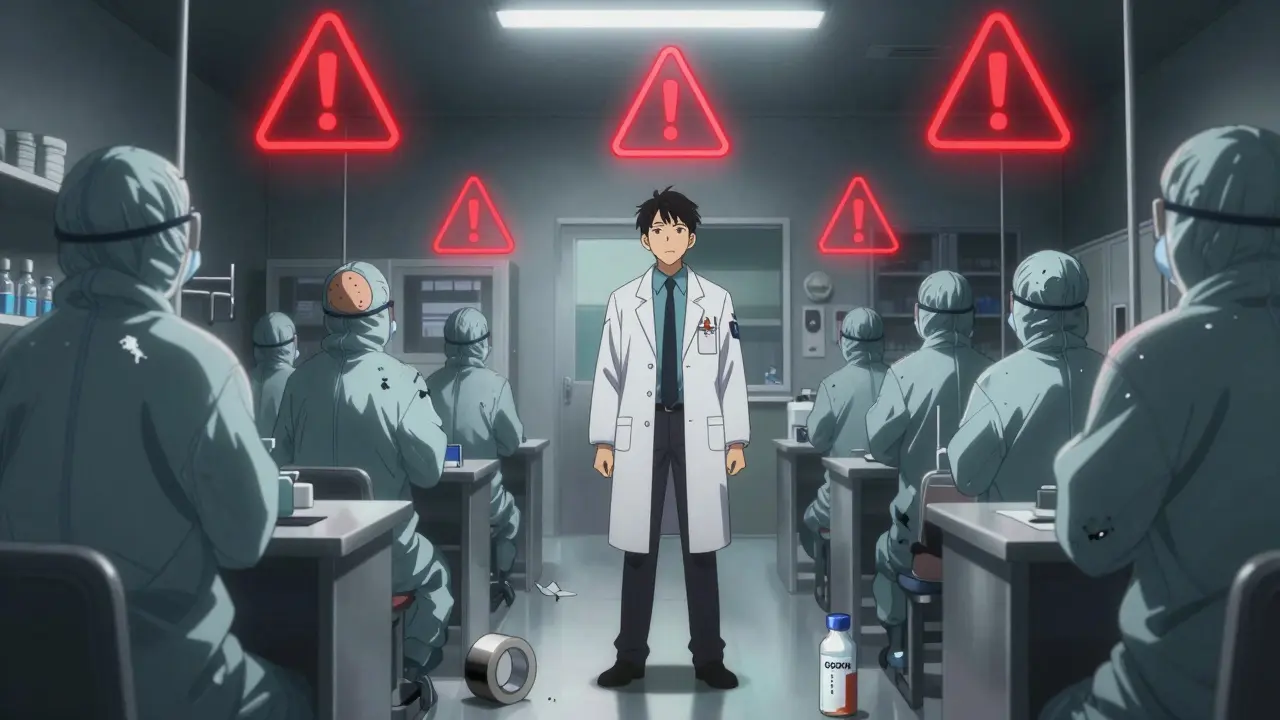
When the FDA issues a warning letter to a drug manufacturer, it’s not just a letter-it’s a red flag that can shut down production, delay product launches, and cost millions. These aren’t gentle reminders. They’re formal, legally binding notices that a company has broken the rules for making safe, effective medicines. And in recent years, they’ve become more common, more detailed, and more damaging.
What Exactly Is an FDA Warning Letter?
An FDA warning letter is the agency’s official way of telling a drug manufacturer: "You’ve violated the law, and we’re documenting it." These letters are issued under the Federal Food, Drug, and Cosmetic Act (FD&C Act) when inspectors find serious problems during facility audits. They’re not optional. They’re not suggestions. They’re enforcement tools designed to force immediate fixes.
Unlike a Form 483-which lists inspection findings but doesn’t carry legal weight-a warning letter is a public record. It’s published on the FDA’s website within 15 business days. That means investors, customers, and competitors can see exactly what went wrong. For a company that makes injectable drugs or sterile products, one warning letter can mean losing contracts, facing import blocks, or even being placed on an import alert.
Since 2022, the number of these letters has been climbing. In 2023, the FDA issued 327 warning letters to pharmaceutical manufacturers worldwide-a 12.7% jump from the year before. That’s not random. It’s a deliberate shift in enforcement strategy.
What Violations Trigger a Warning Letter?
Not every mistake leads to a warning letter. The FDA reserves these for violations that directly threaten product quality, safety, or effectiveness. Most center around Current Good Manufacturing Practices (CGMP), which are the minimum standards for how drugs must be made.
Here are the most common violations cited in 2023 letters:
- Inadequate investigation of out-of-specification (OOS) results - Found in 63.4% of letters. This means a lab finds a batch doesn’t meet purity or potency standards, but the company doesn’t dig deep enough to find out why.
- Poor quality unit oversight - Seen in 57.8% of cases. The quality team isn’t independent or empowered enough to stop production when things go wrong.
- Aseptic processing failures - Mentioned in 78.3% of letters for sterile products. This includes things like workers not wearing proper sterile gowns, using non-sterile tape on filling lines, or exposing skin (like foreheads) in clean rooms.
- Incomplete or missing CAPA systems - Companies often fail to document how they’ll fix a problem and prevent it from happening again.
- Data integrity issues - Now in 67% of letters. This includes deleting electronic records, backdating logs, or not securing data systems.
One 2025 letter to Daewoo Pharmaceutical cited workers touching their foreheads in an ISO 5 cleanroom. Another to Oasis Medical demanded a full review of every batch since January 2023 for defects. These aren’t hypothetical. They’re real, documented failures.
How Does the FDA Decide to Issue a Warning Letter?
The FDA doesn’t send warning letters lightly. They’re typically issued after:
- A routine inspection uncovers multiple CGMP violations.
- A Form 483 is issued, but the company’s response is inadequate or ignores key issues.
- There’s a pattern of repeat violations-especially across multiple facilities owned by the same company.
For example, a 2025 letter to Glenmark Pharmaceuticals didn’t just cite new problems. It pointed back to a warning letter from 2019 at another one of their plants. The FDA was saying: "You’ve been told this before. You didn’t fix it. Now we’re escalating."
Interestingly, foreign facilities are 22% more likely to get a warning letter than U.S. ones for the same violations. A 2023 report raised concerns about whether inspections are equally rigorous across borders.
What Happens After You Get a Warning Letter?
Once you receive it, you have 15 working days to respond. But that’s just the start. The real work begins after.
The FDA expects a detailed, data-backed plan that includes:
- A full root cause analysis-why the problem happened.
- Corrective actions-what you’re doing to fix it now.
- Preventive actions-how you’ll stop it from happening again.
- Verification that the fix works-through testing, monitoring, and documentation.
For instance, the letter to Oasis Medical didn’t just say "fix your quality system." It demanded: "Provide complete results of your examination of retains/reserve samples for all batches from January 2023 to present." That’s not a quick fix. That’s months of lab work.
Most companies take 6 to 12 months to fully respond. The median cost? $1.8 million for U.S. facilities. For foreign ones? $2.7 million. Some small manufacturers say the cost of hiring three consultants just to write the response nearly bankrupted them.
What Are the Real Consequences?
Getting a warning letter isn’t just a paperwork headache. It has real, measurable impacts:
- 68% of companies halt new product submissions while they fix the issues.
- Average delay in regulatory timelines: 8.7 months.
- Stock performance drops 18.4% over 12 months compared to industry peers.
- One company lost $28 million in revenue after a warning letter delayed a single ophthalmic product launch by 14 months.
But there’s hope. Teva Pharmaceuticals received a warning letter in 2021. They responded with a full overhaul of their quality system. Within 11 months, they were removed from the import alert list-and saw a 30% drop in product defects.
Success isn’t about avoiding the letter. It’s about how you respond.
Why Are Warning Letters Increasing?
The number of warning letters has more than doubled since 2018-from 14.2 per month to 27.3 per month in 2023. Why?
- More inspections: The FDA spent $112.7 million on foreign drug inspections in 2023-a 28.5% increase from 2020.
- Focus on data integrity: Electronic records are now a top priority. If you can’t prove your data is accurate, you’re at risk.
- Stricter focus on sterile manufacturing: After the 2022 fungal meningitis outbreak, the FDA is watching aseptic processes like never before.
- Targeting repeat offenders: The FDA’s 2023-2027 plan says it wants to reduce repeat violations by 25% by 2027.
The message is clear: the FDA isn’t just watching. They’re auditing, documenting, and punishing.
What Should Manufacturers Do?
If you’re in drug manufacturing, here’s what you need to do now:
- Know your CGMPs cold. Know 21 CFR 210 and 211 inside and out. Don’t assume your team does.
- Build a strong quality unit. It must be independent, empowered, and funded. No exceptions.
- Invest in data systems. If you’re still using paper logs or unsecured spreadsheets, you’re asking for trouble.
- Train your staff on aseptic practices. One exposed forehead can trigger a warning letter.
- Test your CAPA system. Run mock investigations. See if your team can trace a problem back to its root cause.
- Prepare for inspections. Don’t wait for the FDA to show up. Do internal audits quarterly.
The warning letter system isn’t perfect. It’s inconsistent. It’s expensive. But it’s here to stay. The companies that survive are the ones that treat compliance not as a cost-but as a core part of their business.
What’s the difference between a Form 483 and a warning letter?
A Form 483 is an inspectional observation list given to a company at the end of an FDA inspection. It lists problems found but doesn’t carry legal weight. A warning letter is a formal, public notice that the FDA believes the violations are serious enough to require immediate correction under the law. It’s the next step up-and it’s published online for everyone to see.
Can a company ignore a warning letter?
No. Ignoring a warning letter almost always leads to worse consequences. The FDA can escalate to import alerts (blocking shipments), product seizures, injunctions, or even criminal charges. The agency tracks responses closely. A lack of response is treated as a refusal to comply.
How long does it take to get off the FDA’s warning letter list?
Most companies achieve compliance within 12 to 24 months. But it depends on the severity of the violations and the quality of the response. The FDA typically schedules a follow-up inspection within 6 months. If they’re satisfied, the warning letter is marked as "closed"-but it stays on the public record forever.
Do warning letters affect drug pricing?
Yes. When a manufacturer is under a warning letter, they often pause production or delay new product approvals. This reduces supply, especially for generic drugs. In 2023, 12% of drug shortages were linked to warning letters. Reduced supply + high demand = higher prices.
Are small manufacturers targeted more than big ones?
Not intentionally-but they’re more vulnerable. Big companies have dedicated compliance teams and legal departments. Small manufacturers often lack the resources to respond properly. A 2023 survey found that 54% of small firms waited over 120 days for FDA feedback on their response-longer than the agency’s 45-day target. This delay can be fatal for small businesses.



Aisling Maguire
1 March 2026 - 22:11 PM
I’ve seen so many small labs panic when they get a warning letter. Honestly? The real issue isn’t the violation-it’s the lack of prep. You don’t wait until the FDA shows up to check your gowning logs. You audit yourself weekly. One team I worked with started doing surprise cleanroom drills. Guess what? No warning letters in 3 years. Simple as that.
Sophia Rafiq
2 March 2026 - 11:52 AM
OOS investigations are the silent killer in pharma. Most companies treat it like a checkbox. You find an outlier you don’t dig. You just rerun it till it passes. That’s not quality that’s fraud. The FDA’s not blind. They see the pattern. And they don’t care if you’re small. You break CGMP you get the letter.
Martin Halpin
4 March 2026 - 11:20 AM
Let me tell you something nobody wants to admit. The FDA isn’t trying to protect patients. They’re trying to protect their budgets. More warning letters = more funding = more inspectors = more power. The whole system is a feedback loop of fear. Look at the numbers. 327 letters in 2023. Up 12.7%. That’s not because more companies are failing. That’s because the FDA is hunting. They’ve got quotas. They’ve got KPIs. They’re not regulators. They’re performance athletes. And we’re the targets.
Eimear Gilroy
6 March 2026 - 11:03 AM
I’m curious about the data integrity part. I get that deleting logs is bad but what about when your system crashes and you have to reconstruct records manually? Is that still a violation? Or is there room for human error if you document the recovery? I’ve seen teams rebuild 3 months of data after a server fail and still get flagged. Feels like the rules don’t account for reality.
Ajay Krishna
8 March 2026 - 06:35 AM
To everyone panicking about warning letters: breathe. It’s not the end. Teva proved it. I’ve helped 3 small manufacturers recover from this. The key? Don’t try to impress the FDA with fancy reports. Just show them you actually fixed the problem. Real data. Real testing. Real training logs. No fluff. They’ve seen 1000 of them. They know what’s real. Be honest. Be thorough. And you’ll get through it.
Charity Hanson
8 March 2026 - 11:51 AM
Y’all are making this sound like a horror movie. It’s not. It’s a wake-up call. I’ve been in 5 audits. The ones who survive? They treat compliance like oxygen. Not a cost center. Not a burden. A lifeline. Your product is someone’s medicine. If you cut corners on gowning? That’s not negligence. That’s betrayal. So fix it. Train hard. Document everything. And stop whining. The patients aren’t asking for excuses.
Noah Cline
8 March 2026 - 13:08 PM
You think the forehead thing is harsh? Try working in a facility where the autoclave logs are handwritten on napkins. That’s what I saw in a Tier 2 vendor last year. No electronic records. No audit trail. No validation. Just ‘we’ve always done it this way.’ That’s not incompetence. That’s arrogance. And the FDA’s right to shut you down. No sympathy for lazy.
Lisa Fremder
10 March 2026 - 05:40 AM
Foreign facilities get 22% more letters? That’s because they’re cutting corners. American manufacturers don’t have this problem. We have standards. We have training. We have pride. The FDA’s just exposing the truth. India China Philippines they’re all playing the same game. Pay off inspectors. Skip validation. Ignore gowning. And now they’re getting called out. Good. Let them fail. We don’t need their cheap drugs. We need safe ones.
Justin Ransburg
10 March 2026 - 21:30 PM
This is a critical moment for the industry. The FDA’s actions reflect a shift from reactive enforcement to proactive deterrence. The increase in warning letters correlates directly with enhanced inspectional capacity and the prioritization of data integrity and aseptic practices. Companies that invest in robust quality systems and continuous improvement are not only mitigating risk-they are positioning themselves as industry leaders. Compliance is not an expense. It is a strategic advantage.
Sumit Mohan Saxena
12 March 2026 - 12:34 PM
The root cause analysis requirement is often misunderstood. It is not sufficient to state that a procedure was not followed. The correct methodology requires a structured approach such as the 5 Whys or Fishbone Diagram to identify systemic failures. Furthermore, the corrective and preventive actions must be quantitatively validated through statistical process control and demonstrated over a minimum of three consecutive batches. Without this level of rigor the response is considered inadequate and may trigger further regulatory action.
Brandon Vasquez
13 March 2026 - 12:32 PM
I’ve been on the other side of this. Got a letter last year. Took us 9 months. We didn’t hire consultants. We sat down with every technician. Asked them what was broken. Listened. Then we rebuilt the process together. No blame. Just facts. Now we’re better than ever. It’s not about avoiding the letter. It’s about using it to make things right.
Vikas Meshram
14 March 2026 - 06:01 AM
Data integrity violations are the most dangerous because they undermine the entire foundation of pharmaceutical manufacturing. If records can be altered or deleted without trace then no batch can be trusted. This is not a technical issue it is a moral one. Anyone who falsifies data should be permanently barred from the industry. Period. No exceptions. No leniency. The lives of patients depend on absolute truth in documentation.
Ben Estella
15 March 2026 - 07:31 AM
Let’s be real. The FDA’s playing politics. They’re using warning letters to scare foreign manufacturers into leaving the market so American companies can monopolize. It’s not about safety. It’s about control. You think they inspect U.S. plants this hard? Nah. They’re cherry-picking the easiest targets. And you’re falling for it. Wake up. This isn’t regulation. It’s economic warfare.
Jimmy Quilty
15 March 2026 - 22:00 PM
You know what’s really happening? The FDA’s working with big pharma to eliminate competition. They’ve got algorithms that flag small manufacturers based on location and size. The forehead thing? That’s a trap. They know people touch their faces. They want you to slip. Then they pounce. And once you’re on the list? Your suppliers get scared. Your investors run. Your customers vanish. It’s not a warning. It’s a death sentence. And they’re the ones holding the knife.
Miranda Anderson
17 March 2026 - 02:22 AM
I’ve read through 12 warning letters from the last year. The patterns are terrifying. Not because the violations are wild. But because they’re so basic. Aseptic gowning. Data backups. Independent QA. These aren’t cutting-edge science. They’re fundamentals. And yet so many companies treat them like suggestions. It’s like building a bridge and forgetting the bolts. You don’t need a PhD to fix this. You just need discipline. And the will to do the boring stuff right. The FDA’s just holding up a mirror. The problem was always in the room.