
When cancer patients are prescribed a combination of drugs, it's not just about taking more pills. It's about how those pills work together - and whether a generic version can truly replace the brand-name version without risking treatment failure or dangerous side effects. This is where bioequivalence becomes a make-or-break issue. For single drugs, the rules are clear: a generic must deliver the same amount of active ingredient into the bloodstream at the same rate as the original. But when two or more cancer drugs are combined - like in FOLFOX (5-fluorouracil, leucovorin, oxaliplatin) or R-CHOP (rituximab, cyclophosphamide, doxorubicin, vincristine, prednisone) - the math gets messy. And the stakes? Life or death.
Why Bioequivalence Matters More in Cancer Than in Other Diseases
Most chronic conditions - high blood pressure, diabetes, depression - have some wiggle room. A little too much or too little drug might cause discomfort, but not immediate harm. Cancer treatment is different. The window between killing tumor cells and poisoning healthy ones is razor-thin. A drug like methotrexate, used in many combination regimens, has a narrow therapeutic index. That means even small changes in how much of the drug reaches your bloodstream can turn a cure into a crisis.
The FDA and other global regulators use a standard 80-125% confidence interval to declare bioequivalence. That sounds precise, but in oncology, it’s not enough. Dr. James McKinnell from Johns Hopkins pointed out at the 2023 ASCO meeting that for high-risk combinations, the margin should be tighter - 90-111%. Why? Because when you’re stacking three or four drugs, each with its own absorption pattern, tiny differences add up. One generic might release its drug 5% slower. Another might absorb 7% faster. Alone, those numbers seem harmless. Together? They can shift the entire balance of the treatment.
How Bioequivalence Testing Falls Short for Combinations
Right now, regulators approve generic versions of combination drugs by testing each component separately. That’s the rule. But here’s the problem: when you take a drug by itself in a lab, it behaves one way. When you take it alongside another drug - especially another generic - their interactions can change. One generic might slow down how fast another gets absorbed. Or alter how the liver breaks it down. These aren’t theoretical concerns. A 2023 survey of U.S. oncology pharmacists found that 57% had seen cases where swapping out just one generic component in a combo led to unexpected toxicity or reduced effectiveness.
Take vincristine. It’s part of R-CHOP, one of the most common lymphoma regimens. A case documented on the ASCO Community Forum described a patient who developed severe nerve damage after switching to a generic version. The issue? The generic had a different excipient - an inactive ingredient - that changed how quickly the drug hit peak concentration. That spike in blood levels triggered neurotoxicity. The branded version had never done that. But because regulators only checked if the *average* absorption was within 80-125%, the generic passed. The patient didn’t.
The Biologic Problem: When Generics Aren’t Even the Same Type of Drug
Some cancer combinations mix traditional small-molecule drugs with biologics - like rituximab (a monoclonal antibody) in R-CHOP. Here’s the catch: biologics don’t have generics. They have biosimilars. And biosimilars aren’t approved the same way. While a small-molecule generic only needs to prove it delivers the same amount of drug into the blood, a biosimilar must prove it works the same way in the body - with clinical trials showing it matches the original in safety, purity, and potency.
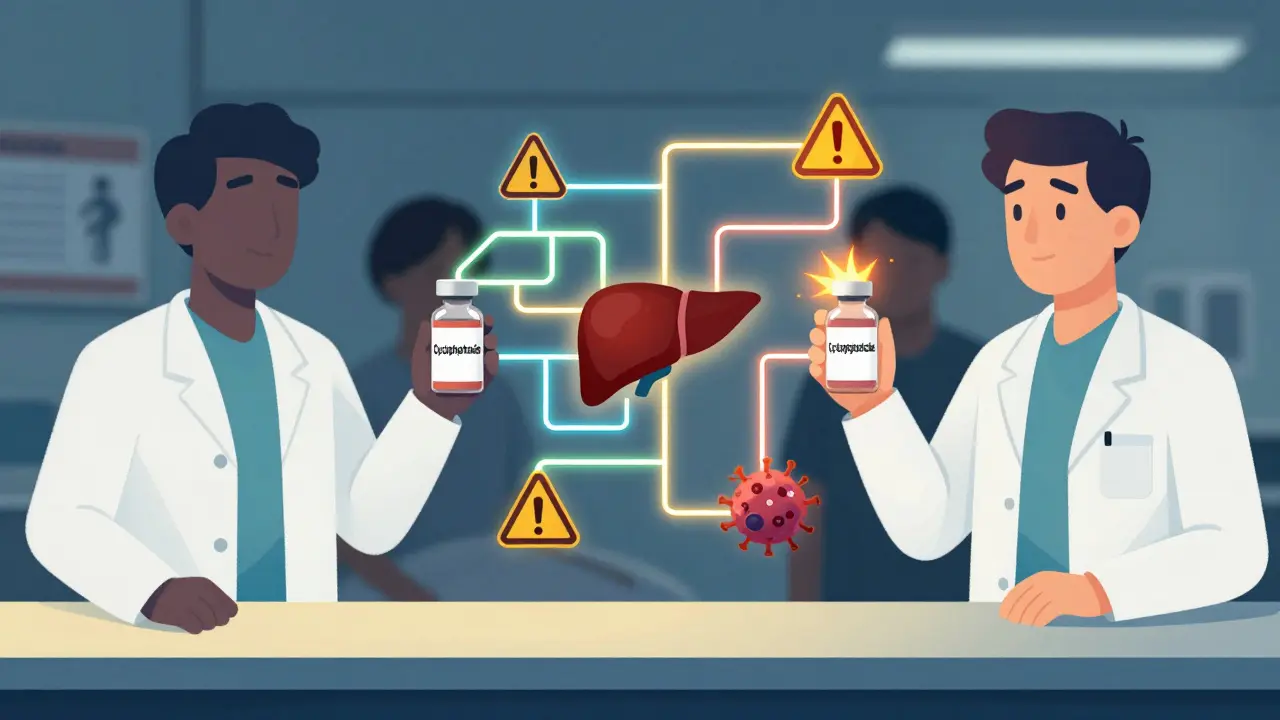
But here’s the loophole: when a combination product includes both a biosimilar and a generic small-molecule drug, regulators don’t test the combo as a whole. They approve each part separately. That means a patient could get a biosimilar of rituximab and a generic version of cyclophosphamide - both individually approved - but no one knows if they still work together the same way the branded combo did. A 2024 study from the Gulf Cancer Consortium found that 42% of oncologists worry about this exact scenario. And most hospitals don’t track which version of each drug a patient received.
Cost vs. Safety: The Real Trade-Off
Let’s be honest: generics save money. Big time. Generic paclitaxel costs 70% less than the brand. Generic capecitabine? 80% cheaper. A single cycle of branded trastuzumab can run over $10,000. The biosimilar? Around $4,000. For a patient on Medicare or a high-deductible plan, that’s life-changing.
But cost savings shouldn’t come at the cost of safety. A 2024 analysis from MD Anderson showed that when generic capecitabine replaced branded Xeloda in combination with oxaliplatin, overall survival was nearly identical - 27.9 months vs. 28.4 months. That’s reassuring. But that study looked at 1,247 patients over several years. What about the one patient who got a bad batch? The one whose body reacted differently? The data doesn’t capture that.
And it’s not just about the drug. It’s about trust. A 2024 survey by Fight Cancer found that 63% of patients worry about switching to generics in combination therapy. 41% said they’d ask for branded drugs if they could afford them. That’s not just fear - it’s experience. Patients have seen friends get sicker after a switch. They’ve heard stories. And no amount of regulatory approval changes that.
What’s Being Done - And What’s Still Missing
Regulators are starting to catch on. In 2024, the FDA launched the Oncology Bioequivalence Center of Excellence - its first dedicated team focused on combination therapies. The European Medicines Agency is running pilot programs to test entire regimens as a unit, not component by component. The International Consortium for Harmonisation of Bioequivalence Standards released new guidelines in March 2024, recommending tighter bioequivalence margins (90-111%) for narrow therapeutic index drugs in combos.
Some hospitals are building their own safeguards. UCSF developed a decision support tool that flags high-risk substitutions in real time. If a patient is on a combo with methotrexate or vincristine, the system alerts the pharmacist before the switch is made. The University of California system cut inappropriate substitutions by 63% using this tool.
Meanwhile, formularies are getting smarter. The Gulf Cooperation Council created a scoring system that weighs 12 factors: manufacturing quality (30%), regulatory alignment (25%), cost (20%), supply reliability (15%), and patient trust (10%). It’s not perfect - but it’s a step toward treating these drugs like the complex, life-saving tools they are.

What Patients and Providers Need to Know
If you’re on a combination regimen, here’s what you need to do:
- Ask your oncologist or pharmacist: Which version of each drug am I taking? Don’t assume it’s the same as last time.
- Track side effects. If you notice new tingling, fatigue, nausea, or a drop in blood counts after a refill - speak up. It might not be the cancer. It might be the generic.
- Know your drugs. Some combinations - like FOLFOX, R-CHOP, or carboplatin/paclitaxel - are high-risk. Others, like capecitabine + oxaliplatin, have strong data supporting generics.
For providers: Don’t rely on the Orange Book alone. Just because a drug has an ‘A’ rating doesn’t mean it’s safe to swap in a combo. Use institutional guidelines. Demand clinical data. And when in doubt - stick with the original.
The Future: Modeling, Simulation, and Personalized Bioequivalence
The next frontier isn’t just more trials. It’s modeling. The FDA’s 2023 draft guidance now endorses physiologically based pharmacokinetic (PBPK) modeling - computer simulations that predict how drugs interact in the body. Imagine inputting the exact formulation of a generic, the patient’s age, liver function, and other meds - and the model tells you if the combo will still work. This isn’t sci-fi. It’s being tested right now.
By 2030, the National Cancer Institute estimates that 35-40% of current combination regimens will need entirely new bioequivalence protocols. That means regulators, manufacturers, and clinicians will have to rethink how we define “the same.” It’s not just about how much drug gets in. It’s about how it behaves - together.
Can generic cancer drugs be safely substituted in combination therapy?
Some can, but not all. Single-agent generics like paclitaxel or capecitabine have strong evidence supporting substitution. But in multi-drug regimens - especially those with narrow therapeutic index drugs (like vincristine or methotrexate) or biologics - substitution carries risk. The FDA and EMA approve each component separately, but they don’t test the combo as a whole. Clinical evidence shows that switching one generic component can lead to unexpected toxicity or reduced efficacy. Always consult your oncology team before any substitution.
Why do some cancer generics cause side effects that the brand didn’t?
It’s often not the active drug - it’s the inactive ingredients. Excipients like fillers, coatings, or solvents can change how quickly a drug dissolves or is absorbed. A generic vincristine might release its drug faster than the brand, leading to a spike in blood levels that triggers nerve damage. Or a generic oxaliplatin might have a different pH, affecting how it interacts with other drugs in the IV bag. These small differences are invisible in standard bioequivalence tests, which only measure average absorption.
Are biosimilars the same as generics for cancer drugs?
No. Generics are exact chemical copies of small-molecule drugs. Biosimilars are highly similar - but not identical - versions of complex biologic drugs like rituximab or trastuzumab. They’re made from living cells, so they can’t be copied exactly. Biosimilars require clinical trials to prove safety and effectiveness, while generics only need bioequivalence studies. When a combination includes both a biosimilar and a generic, regulators approve them separately - but no one tests how they work together in the body.
How can I know if my cancer drug has been switched to a generic?
Always ask. Pharmacies aren’t required to notify patients when switching to a generic unless state law says otherwise. Check the pill bottle or IV bag - the manufacturer name will be different. If you’re unsure, ask your pharmacist: "Is this the same brand I was on before?" If you notice new side effects after a refill, report them immediately. Your oncology team needs to know.
What’s being done to fix the bioequivalence problem in cancer combos?
The FDA launched the Oncology Bioequivalence Center of Excellence in 2024 to tackle these issues. The EMA is piloting tests of entire regimens, not just single drugs. New international guidelines now recommend tighter bioequivalence limits (90-111%) for high-risk drugs. Hospitals are using decision-support tools to block unsafe substitutions. And researchers are using computer modeling to predict how generics interact - a major step toward personalized safety.
What’s Next?
The push for affordable cancer drugs isn’t going away. Generics and biosimilars will keep entering the market. But we can’t keep treating combination therapies like they’re just a pile of pills. We need smarter rules, better testing, and more transparency. Until then, patients and providers must stay vigilant. The right drug, at the right time, in the right form - that’s what saves lives. Not just the cheapest option.





Robert Bliss
8 March 2026 - 11:56 AM
Just had my first generic combo switch last month. FOLFOX with a new generic oxaliplatin. Started getting weird numbness in my fingers. Didn't think much of it till my nurse asked if anything changed. Turned out it was the switch. They put me back on brand. Still alive. Still got my hair. 😅
Peter Kovac
9 March 2026 - 05:46 AM
The regulatory framework for combination bioequivalence is fundamentally flawed. The 80-125% confidence interval, derived from chronic disease pharmacokinetics, is statistically inappropriate for narrow therapeutic index oncologic agents. The assumption of additive pharmacokinetic behavior ignores non-linear drug-drug interactions, particularly in hepatic metabolism via CYP450 isoforms. Regulatory bodies must adopt population pharmacokinetic modeling and conduct in vivo interaction studies for multi-drug regimens, not component-by-component analysis.
APRIL HARRINGTON
11 March 2026 - 03:00 AM
OMG I CANNOT BELIEVE THIS IS HAPPENING TO PEOPLE 😭
My aunt went from feeling fine to almost dying after they switched her meds. They said "it's the same drug" but it wasn't! She was in the hospital for 3 weeks. Now I check every single pill bottle like my life depends on it. And it kinda does. 🙏
Leon Hallal
11 March 2026 - 12:23 PM
They don't care. Big Pharma makes billions on brand names. Generics are cheaper to make but they're still making money. The system is rigged. Patients are the lab rats. You think they test these combos on real people before letting them go out? Nah. They test on spreadsheets. And then we pay the price.
Judith Manzano
13 March 2026 - 03:04 AM
This is such an important conversation. I work in oncology pharmacy and I see this every week. The truth is, most patients don't even know they've been switched. And when they do, they're too scared to ask questions. We need better labeling, better education, and better tracking. But honestly? The biggest win would be if insurers stopped forcing switches on high-risk combos. It's not saving money if someone ends up in the ICU.
rafeq khlo
14 March 2026 - 02:02 AM
Western medicine is a scam. The FDA is corrupted by pharmaceutical lobbies. They approve generics without testing interactions because they want to save money for insurance companies. The real solution is natural remedies. Curcumin. Vitamin D. Fasting. These have been proven for centuries. But they don't make money. So they push poison pills with fake labels. You think your life matters? It doesn't. You're just a number in their profit spreadsheet.
Morgan Dodgen
15 March 2026 - 03:40 AM
Let’s be real - the FDA’s 80-125% bioequivalence window is a joke. It’s like saying two helicopters are equivalent if they both fly between 45 and 55 mph. What about torque? Fuel efficiency? Rotor dynamics? The same applies here. PBPK modeling is the future - but even that’s just a band-aid. We need FDA to mandate combo-specific bioequivalence trials. And until then? If you’re on R-CHOP? Demand the brand. Or you’re gambling with your life. And no, I’m not paranoid. I read the studies. And the studies don’t lie.
Philip Mattawashish
15 March 2026 - 08:35 AM
You people are naive. You think regulators care about you? They care about liability. They care about lawsuits. They care about quarterly reports. Your life? It’s a footnote. If a generic saves $3,000 per patient and kills one person every 10,000 switches? That’s a net positive for the system. You’re not a patient. You’re a cost center. And you’re being optimized out. Wake up.
Tom Sanders
15 March 2026 - 20:31 PM
So what’s the point of all this? I just want to live. Can we get to the answer? Should I ask for brand? Or is it fine? I’m tired of reading all this jargon. Just tell me what to do.
Jazminn Jones
17 March 2026 - 16:08 PM
The notion that bioequivalence can be assessed via single-agent pharmacokinetics in the context of polypharmacy is methodologically indefensible. The absence of pharmacodynamic synergy assessments, coupled with the omission of inter-patient variability in drug transporters and metabolic enzymes, renders current regulatory paradigms obsolete. The EMA’s pilot programs, while commendable, remain insufficient without mandatory pharmacogenomic stratification in clinical equivalence trials.
George Vou
18 March 2026 - 12:03 PM
generic = bad. brand = good. its that simple. they dont test the combo. they test one pill at a time. but you take them all together. so its like mixing bleach and ammonia and saying "its fine because bleach is safe and ammonia is safe". duh. i dont trust any of this. my oncologist said dont switch. so i dont. simple.
Scott Easterling
19 March 2026 - 18:30 PM
Wait - so you’re telling me the FDA approves a generic version of vincristine… but doesn’t test how it interacts with the generic version of leucovorin? That’s insane. And then they wonder why people are scared? Of course people are scared! They’re being used as guinea pigs. And hospitals? They don’t even track which version you got. How is this legal? It’s not. It’s criminal negligence.
Mantooth Lehto
20 March 2026 - 05:40 AM
I had a friend die because they switched her combo. She was fine. Then one day she just… stopped responding. They said "it was the cancer". But I know. The pills looked different. She asked. They said "it’s the same". It wasn’t. I’m so angry. I’m so scared. If you’re on combo chemo? Don’t let them switch. Fight. Demand the brand. Your life is worth more than a $500 savings. 💔
Melba Miller
20 March 2026 - 12:15 PM
America’s healthcare system is broken. We let corporations decide who lives and dies. Generics? Fine for high blood pressure. Not for cancer. We need a public option for cancer drugs. No profit. No generics. Just the right drug. The right dose. The right brand. No exceptions. No cost-cutting. No compromises. If you can’t afford it? We pay. Because in America, your life shouldn’t be priced by a spreadsheet.